Bring AI to
Every Industrial Data Stream
Built on a high performance time series database, industrial ontology, and industrial agent runtime, TDengine brings AI capabilities to industrial scenarios, providing a full-stack solution for industrial data, from collection, storage, and real-time analysis to visualization, event management, and root cause analysis. A modern alternative to data historian.

Trusted by over 1,000 industrial companies worldwide










Why TDengine
Modernize your industrial data historian
Get everything you rely on from traditional data historians such as the AVEVA PI System, from data collection and asset modeling to visualization, events, calculations, reporting, security, and high availability, plus advanced analytics and AI-powered insights in one integrated platform.
Extreme performance for massive data streams
A purpose-built time-series architecture handles high-volume, high-cardinality sensor data with millisecond-scale ingestion, queries, and real-time analysis—delivering more than 10× the performance of general-purpose databases while reducing storage costs by up to 90%.
AI-Driven decisions, from days to minutes
Industrial ontology gives AI the context to analyze operating behavior, identify anomalies, uncover insights, and investigate potential causes, bringing expert-level analytical capabilities directly to frontline teams.
The AI-native Industrial Data Platform

Bring industrial data together with zero code, then store it efficiently
TDengine connects to OPC, MQTT, Kafka, and other industrial data sources. Built-in ETL handles cleaning and transformation before the data enters the platform.
Its storage engine delivers more than 10 times the write and query performance of general-purpose databases, while reducing storage costs to one tenth. Multi-level storage and hot/cold tiering help it support hundreds of millions of Data Collection Points reliably.
Give AI the context behind your data with industrial ontology
TDengine builds a unified business information layer between storage and applications. Asset hierarchies are organized in a tree structure, while network models describe horizontal relationships between devices.
Through data standardization and contextualization, scattered raw data becomes meaningful industrial assets. AI can then follow business context through the plant, instead of working only with database names and table names.


Turn live data streams into operational insight
TDengine supports a wide range of industrial monitoring scenarios, with multiple trigger types for different operating needs. Teams can build real-time monitoring logic through a visual interface, or describe the requirement in natural language and let AI suggest the configuration.
Each trigger creates a structured event with full context, connecting detection, analysis, and response. High-frequency industrial data becomes insight that engineers can review and AI can use for reasoning and action.
Put AI to work in real operations with industrial agent runtime
TDengine connects to major LLMs without tying users to a built-in model or a single vendor. Its knowledge base turns private enterprise documents into a searchable knowledge graph. Skills convert industrial know-how into standard workflows that AI agents can call.
Thirteen built-in AI assistants support the workflow from data queries and panel creation to root cause analysis and report generation. The security model is built around control, trust, auditability, and resilience, so AI strengthens operations without becoming a single point of dependence.


Process analytics helps engineers trace problems to their source
TDengine provides a no-code analysis workbench for multi-event comparison, scatter chart regression, clustering, trend forecasting, and similarity search.
Statistical calculations run inside the database, so engineers do not need to export data before analysis. They can investigate problems where they appear, trace them back to likely causes, and turn operating experience into practical decisions.
Process analyticsProvide an open platform that keeps pace with fast-moving AI technology
TDengine uses a loosely coupled, modular architecture. Each component can be deployed, scaled, or replaced independently. Through the Model Context Protocol (MCP), more than 50 system capabilities can be exposed to external AI agents.
Automation teams can use the CLI, while developers can work with a REST API described by the OpenAPI Specification. JDBC, ODBC, Kafka, MQTT, iframe embedding, and Excel Add-In support keep semantic data available across tools and workflows. TDengine can run in the public cloud, on premises, or in edge-cloud deployments without locking users into one vendor stack.


Turn tacit know-how into reusable assets with knowledge management
TDengine turns tacit enterprise knowledge into five manageable forms. Industrial Ontology gives data business meaning. Documents become a searchable knowledge graph. Calculation expressions turn expert judgment into monitoring logic that keeps running. Analysis models run directly in the database. Skills package complex tasks as standard workflows for AI agents.
Five-tier security policies protect this knowledge across the process, and the knowledge remains under the user’s control. What used to live in individual memory becomes a reusable enterprise asset.
Knowledge ManagementTDengine Overall Architecture

TDengine consists of two integrated components:
- TDengine TSDB: high-performance time-series database
- TDengine IDMP: AI-powered industrial data management platform
TDengine TSDB has built-in data ingestion, data storage, and query processing engines. TDengine IDMP includes an industrial ontology, atomic applications, and the Industrial Agent Runtime.
The two integrate into a single AI-native industrial data platform. It covers data collection, storage, analysis, visualization, and AI applications. Raw data goes in, operational decisions come out. A modern alternative for data historian.
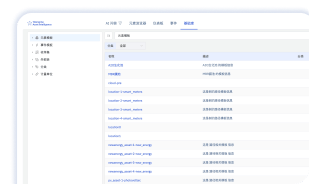
TDengine Industrial Use Cases
Discover how TDengine is used in real operational scenarios
Explore More Industrial Use Cases


Data Encryption

Role-based Access Controls

IP Whitelisting

Data Backup & Restoration

Disaster Recovery

24/7 Support
Security & Compliance
Learn MoreProudly Open Source
TDengine TSDB-OSS, a fully open-source time-series database that includes clustering capabilities, serves as the foundation for all our paid offerings. Along with our vibrant open-source community, TDengine TSDB-OSS continues to innovate in the field of time-series data management.

1,515.4K
Instances
worldwide

24,000
GitHub
stars

20,000+
Community
members



Latest Updates
This article compares TDengine and PI System to help you make informed decisions about your data management strategy.
Compare PI System with TDengine

by Jeff Tao
October 19, 2026
Across three production energy sites, TDengine uses about 2% of one CPU core per appliance—leaving compute available for real-time control and local AI. At DJIN EMS, we record 35 million rows of energy data every day with TDengine TSDB. By September 2026, our three operating sites had accumulated more than two billion rows in under
How DJIN EMS Captures 35 Million Rows a Day with TDengine at the Grid Edge

by Nick Hughes
October 14, 2026
Industrial data rarely lives in one place. A plant may rely on a historian for process data, a relational database for asset or production information, a time series database for newer applications, and other systems for maintenance, quality, or operational context. Over time, that creates a data landscape made up of different technologies, schemas, and
TDengine IDMP Opens the Industrial Data Layer
by TDengine Team
October 7, 2026
A chemical plant engineer without a formal software development background used an AI Agent and the TDengine IDMP SDK to build and deploy an industrial-grade web application for the full alarm lifecycle in three days. The case shows how TDengine can serve as an industrial data foundation in the AI era: TDengine uses AI, and
How a Factory Built an Industrial Alarm Management App with TDengine in Three Days

by Arun Arulraj
September 28, 2026
Introduction Zendure’s plug-and-play home energy management systems are backed by a home energy storage data platform. Its solar storage devices are used in more than 60 countries and regions in Europe, North America, and Asia-Pacific, with more than 1.17 million connected devices. The product line grew from one storage category to nine, including solar flow
How Zendure Scaled Its Home Energy Platform to 1.17 Million Devices—and Cut Storage Costs by 80%
by Arun Arulraj
September 11, 2026
In this walkthrough, we’ll show how to ingest that live MQTT data into TDengine TSDB for high-performance storage and querying, and then use TDengine IDMP to model assets and perform visualization and analytics.
Build Your First Industrial Data Stack with TDengine Through an MQTT Broker
by Arun Arulraj
August 24, 2026
We’re excited to announce the launch of a free, public MQTT data feed that simulates a realistic California solar fleet.
Free Public MQTT Data Feed: Real-Time Solar Fleet Simulation Now Available
by Arun Arulraj
August 21, 2026
Hands-On Scenario: Solar Power Monitoring Workshop objective: You are responsible for monitoring a solar installation with multiple inverters. During the workshop, you’ll turn raw solar telemetry into an organized equipment model, operational analytics, a live dashboard, and AI-powered insights. Before We Start: Your Data Is Already Ready There is no data ingestion setup required for this
TDengine Free Tier Workshop Manual
by Arun Arulraj
August 12, 2026
The TDengine Free Tier gives organizations of any size full functionality and performance—from time-series data management and industrial modeling to advanced analytics and AI, with no trial deadline SAN JOSE, Calif. — July 28, 2026 — TDengine, the AI-powered data platform for industrial applications, today announced the global availability of the TDengine Free Tier, making the complete
TDengine Makes Its Complete AI-Native Industrial Data Platform Free Forever for Up to 5,000 Tags
by TDengine Team
July 28, 2026


