TDengine All-in-One:
The Modern PI System Alternative
Replace legacy PI System deployments with a modern industrial data historian built for lower cost, easier deployment, open integrations, and AI-ready operations.
Problems with PI System
Industrial enterprises have relied on PI System for decades. Today, many teams are reassessing whether their historian architecture still meets current requirements for cost, openness, cloud integration, AI, and multi-site scalability.

High costs with no perpetual licensing
Rising subscription fees and costly add-on charges

Inconsistent edge and cloud solutions
Legacy design that complicates cross-site deployment

Lack of AI/LLM support
No built-in AI or LLM capabilities, requiring external integration
Vendor lock-in
Proprietary formats that block data export and integration
Why TDengine?
TDengine Historian is a modern alternative to PI System, delivering AI-driven intelligence, a unified user experience, and the freedom to use your data how you want, all at an affordable price.

Reasonable pricing with perpetual option
Perpetual and annual licensing available at one-third the cost of PI System

Unified experience across platforms
Deploy the same product on-premises, hybrid, or cloud with full synchronization capabilities

AI copilot
Optional AI-based anomaly detection, predictive analytics, and LLM-powered insights out of the box

No vendor lock-in
Ingest from OPC UA, MQTT, and more at no extra cost, connect easily to BI and AI tools, and export your data to other systems whenever you want
Replace PI System Workflows, Not Just the Data Archive
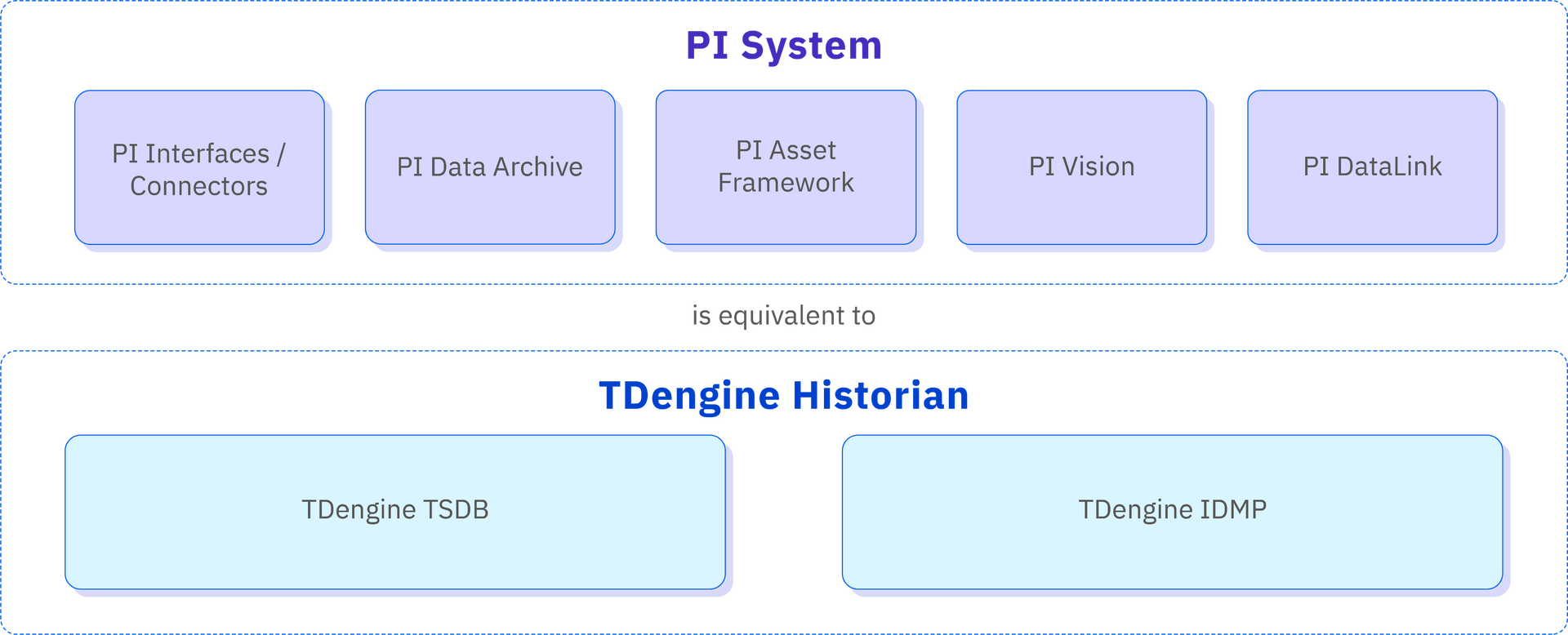
Replacing PI System means replacing more than the data archive.
PI users also depend on asset modeling, dashboards, Excel reporting, events, buffering, security, and integrations.
TDengine Historian provides functional coverage across these major PI workflows in one modern platform.
| Capability | PI component / workflow | TDengine coverage |
|---|---|---|
| Historical data storage | PI Data Archive / PI Server | TSDB time-series storage, compression and querying |
| Asset modeling and context | PI Asset Framework | IDMP asset hierarchies, templates, attributes and metadata |
| Calculations and derived metrics | PI AF Analytics / Analysis Service | IDMP real-time analyses and calculated attributes, powered by TSDB stream processing |
| Events and production analysis | PI Event Frames | Event templates, detection, history and event comparison |
| Dashboards and process displays | PI Vision / ProcessBook | IDMP dashboards, trends, Canvas and process visualization |
| Excel analysis and reporting | PI DataLink | Excel Add-In for current values, historical data, aggregations, events and asset information |
| Alerts and notifications | PI Notifications | Event-based notifications, acknowledgment, repeat notifications and escalation |
| Industrial data collection | PI Interfaces / Connectors / AVEVA Adapters | taosX connectors for OPC UA, OPC DA, MQTT, PI, files and databases |
| Collection buffering | PI Buffer Subsystem | Configurable taosX-Agent disk buffering and automatic forwarding after network recovery |
| Historian high availability | PI Collective | High availability across connectors, TSDB, and IDMP |
| Multi-site data distribution | PI-to-PI / enterprise data sharing | taosX replication across plant, enterprise and cloud deployments |
| Application and BI integration | PI Web API / SDKs / data-access tools | SQL, JDBC, ODBC, REST APIs and language SDKs |
| Security and auditability | PI access control / audit tools | Roles, permissions, configurable audit logging and configuration version control |
Feature Comparison: PI System vs. TDengine Historian
See a detailed comparison here, or view the tables below to find specific features
| PI System | TDengine | |
|---|---|---|
| Tree structure | Yes | Yes |
| Element references | Yes | Yes |
| Process model | Yes | Yes |
| Traits for attributes | Yes | Yes |
| Data reference setting | Yes | Yes |
| Units of measurement | Yes | Yes |
| Templates & base templates | Yes | Yes |
| Search/Filter | Yes | Yes |
| Version control | Yes | Yes |
| PI System | TDengine | |
|---|---|---|
| Triggers | Data input, periodic | Data input, periodic, and more |
| Expression analysis | Yes | Yes |
| Rollup analysis | Yes | Yes |
| Event frame analysis | Yes | Yes |
| SQC analysis | Yes | No |
| Backfill and recalculation | Yes | Yes |
| PI System | TDengine | |
|---|---|---|
| Value capture | Yes | Yes |
| Acknowledge event frames | Yes | Yes |
| Transfer | Yes | No |
| Data reference to elements | Yes | Yes |
| Event templates | Yes | Yes |
| PI System | TDengine | |
|---|---|---|
| Notification templates | Yes | Yes |
| Trigger criteria | Yes | Only based on severity level |
| Delivery endpoints | Yes | Yes |
| Escalation | Yes | Yes |
| PI Vision | TDengine | |
|---|---|---|
| Chart types | Trend, Value, Table, Asset Comparison Table, Time Series Table, Gauges, Bar Chart, XY Plot | All PI Vision types + Pie Chart, Rich Text, Map, State Timeline, Status History |
| Chart configuration | Very limited | Grafana-level configuration, several times richer |
| Event frames | Supported | Full compatibility + event duration normalization |
| Animation | Limited (multi-state color change only) | Full SCADA-grade animation, dynamic control of 10+ properties (color, position, text, value, progress, state, etc.), flow animation for pipes |
| Object connectors | Not supported | Fully supported (anchor points, auto-move, animated pipes) |
| Embedding in other applications | Limited, old-style | Modern token-based embedding for integration |
| Advanced analytics | Not supported | Start/stop expressions to search values directly in trends, clustering, and regression |
| Advanced query result display | Not supported | Direct SQL query visualization |
| Notification | Not supported | A snapshot of panel or dashboard can be sent to contact points on a predefined schedule |
| 2.5D symbols | Not supported | Supported |
| AI capabilities | Not supported | Auto-generated panels, natural language dashboard creation, and one-click data insights |
| PI System | TDengine | |
|---|---|---|
| OPC | Yes | Yes |
| MQTT | Yes | Yes |
| Kafka | No | Yes |
| Relational databases | Yes | Yes |
| CSV files | Yes | Yes |
| Other industrial protocols | Yes | No |
| PI System | TDengine | |
|---|---|---|
| REST API | Yes | Yes |
| Kafka | No | Yes |
| MQTT | No | Yes |
| PI System | TDengine | |
|---|---|---|
| Role-based access control (RBAC) | Yes | Yes |
| Single sign-on (SSO) | Yes | Yes |
| Data encryption | Yes | Yes |
| SOC 2 certification | Yes | Yes |
| ISO 27001 certification | Yes | Yes |
| PI System | TDengine | |
|---|---|---|
| Server access | Dedicated client program on windows | Browser |
| Windows | Yes | Yes |
| Linux | No | Yes |
| Installation package | Yes | Yes |
| Ansible deployment | No | Yes |
| Helm deployment | No | Yes |
| Cloud service | Not the same as on-prem solution | Same as on-prem |
| Supported cloud platforms | Azure | Azure, AWS, and GCP |
| PI System | TDengine | |
|---|---|---|
| REST API | Yes | Yes |
| JDBC and ODBC | Yes | Yes |
| Power BI | Yes | Yes |
| Tableau | Yes | Yes |
| Seeq | Yes | Yes |
| Grafana | Yes | Yes |
| Excel | Yes | Yes |
| PI System | TDengine | |
|---|---|---|
| Chat BI | No | Yes |
| Zero-Query Intelligence | No | Yes |
| AI-based time-series forecasting | No | Yes |
| AI-based anomaly detection | No | Yes |
| Integration with third-party AI applications | Hard | Easy |
| PI System | TDengine | ||
|---|---|---|---|
| Asset Modeling | Tree structure | Yes | Yes |
| Element references | Yes | Yes | |
| Process model | Yes | No | |
| Traits for attributes | Yes | Yes | |
| Data reference setting | Yes | Yes | |
| Units of measurement | Yes | Yes | |
| Templates & base templates | Yes | Yes | |
| Search/Filter | Yes | Yes | |
| Version control | Yes | Yes | |
| Asset Analytics | Triggers | Data input, periodic | Data input, periodic, and more |
| Expression analysis | Yes | Yes | |
| Rollup analysis | Yes | Yes | |
| Event frame analysis | Yes | Yes | |
| SQC analysis | Yes | No | |
| Backfill and recalculation | Yes | Yes | |
| Event Frames | Value capture | Yes | Yes |
| Acknowledge event frames | Yes | Yes | |
| Transfer | Yes | No | |
| Data reference to elements | Yes | Yes | |
| Event templates | Yes | Yes | |
| Notifications | Notification templates | Yes | Yes |
| Trigger criteria | Yes | Only based on severity level | |
| Delivery endpoints | Yes | Yes | |
| Escalation | Yes | Yes | |
| Visualizations | Chart types | Trend, Value, Table, Asset Comparison Table, Time Series Table, Gauges, Bar Chart, XY Plot | All PI Vision types + Pie Chart, Rich Text, Map, State Timeline, Status History |
| Chart configuration | Very limited | Grafana-level configuration, several times richer | |
| Event frames | Supported | Full compatibility + event duration normalization | |
| Animation | Limited (multi-state color change only) | Full SCADA-grade animation, dynamic control of 10+ properties (color, position, text, value, progress, state, etc.), flow animation for pipes | |
| Object connectors | Not supported | Fully supported (anchor points, auto-move, animated pipes) | |
| Embedding in other applications | Limited, old-style | Modern token-based embedding for integration | |
| Advanced analytics | Not supported | Start/stop expressions to search values directly in trends, clustering, and regression | |
| Advanced query result display | Not supported | Direct SQL query visualization | |
| Notification | Not supported | A snapshot of panel or dashboard can be sent to contact points on a predefined schedule | |
| 2.5D symbols | Not supported | Supported | |
| AI capabilities | Not supported | Auto-generated panels, natural language dashboard creation, and one-click data insights | |
| Data Ingestion | OPC | Yes | Yes |
| MQTT | Yes | Yes | |
| Kafka | No | Yes | |
| Relational databases | Yes | Yes | |
| CSV files | Yes | Yes | |
| Other industrial protocols | Yes | No | |
| Data Distribution | REST API | Yes | Yes |
| Kafka | No | Yes | |
| MQTT | No | Yes | |
| Security | Role-based access control (RBAC) | Yes | Yes |
| Single sign-on (SSO) | Yes | Yes | |
| Data encryption | Yes | Yes | |
| SOC 2 certification | Yes | Yes | |
| ISO 27001 certification | Yes | Yes | |
| Application | Server access | Dedicated client program on windows | Browser |
| Platforms & Deployment | Windows | Yes | Yes |
| Linux | No | Yes | |
| Installation package | Yes | Yes | |
| Ansible deployment | No | Yes | |
| Helm deployment | No | Yes | |
| Cloud service | Not the same as on-prem solution | Same as on-prem | |
| Supported cloud platforms | Azure | Azure, AWS, and GCP | |
| Integrations | REST API | Yes | Yes |
| JDBC and ODBC | Yes | Yes | |
| Power BI | Yes | Yes | |
| Tableau | Yes | Yes | |
| Seeq | Yes | Yes | |
| Grafana | Yes | Yes | |
| Excel | Yes | Yes | |
| AI | Chat BI | No | Yes |
| Zero-Query Intelligence | No | Yes | |
| AI-based time-series forecasting | No | Yes | |
| AI-based anomaly detection | No | Yes | |
| Integration with third-party AI applications | Hard | Easy |
Transparent, Predictable Pricing
With PI System, costs explode as you add more tags. TDengine is different.
TDengine uses transparent, tag-based pricing with annual and perpetual license options, making it easier to estimate costs.
| Tag limit | Annual license support included | Perpetual license | |
|---|---|---|---|
| One-time price first year support included | Optional annual support from year two |
||
| 7,500 | $12,500 | $37,500 | $5,625 |
| 10,000 | $15,500 | $46,500 | $6,975 |
| 15,000 | $19,000 | $57,000 | $8,550 |
| 20,000 | $22,000 | $66,000 | $9,900 |
| 25,000 | $24,000 | $72,000 | $10,800 |
| 30,000 | $26,000 | $78,000 | $11,700 |
| 40,000 | $28,000 | $84,000 | $12,600 |
| 50,000 | $31,000 | $93,000 | $13,950 |
| 75,000 | $38,000 | $114,000 | $17,100 |
| 100,000 | $46,000 | $138,000 | $20,700 |
| 150,000 | $56,000 | $168,000 | $25,200 |
| 200,000 | $64,000 | $192,000 | $28,800 |
| 250,000 | $72,000 | $216,000 | $32,400 |
| 300,000 | $79,000 | $237,000 | $35,550 |
| 400,000 | $92,000 | $276,000 | $41,400 |
| 500,000 | $110,000 | $330,000 | $49,500 |
| Over 500,000 | |||
| Unlimited tags | |||
Trusted by Industry Leaders
Organizations in energy, manufacturing, and life sciences already rely on TDengine technology to manage billions of data points every day.







By combining TDengine’s scalable time-series engine with semantic integration, we’ve created a unified view of machine operations and domain knowledge that is both high-performance and explainable. This semantic approach lets us ask cross-domain questions and combine expert logic with real-time data — without building fragile custom pipelines.
Stefan Bischof
Senior Research Scientist
Siemens

TDengine has been a game-changer for us. Its features designed for industrial use cases, such as native replication and HA, as well as stream processing, have far exceeded our expectations. Of course, the performance is also brilliant, capable of running well on the edge and in the cloud. The support from the TDengine team has been exceptional, making our transition seamless and ensuring our success from day one.
Alex Tolenaar
Technical Specialist
Extracellular

Seamless Migration
Switching doesn’t have to be painful. TDengine offers:
Flexible deployment: on-prem, hybrid, or cloud.

Proven migration tools for PI data and models.

Fast time-to-value: pilots in weeks, full rollout in 8–12 weeks.
Migrate from PI System without a rip-and-replace project
Use TDengine’s migration approach to stream real-time data, backfill historical data, and modernize in phases while preserving operational continuity.
Migration Flow
1
Connect to existing PI data sources
2
Stream real-time data into TDengine
3
Backfill historical data as needed
4
Modernize applications and dashboards over time
Planning a PI System Migration?
Tell us about your current tags, AF models, calculations, and migration requirements.
We can review your setup and discuss a practical migration path to TDengine.
Learn More
This article compares TDengine and PI System to help you make informed decisions about your data management strategy.
Compare PI System with TDengine

by Jeff Tao
October 19, 2026
TDengine makes digital transformation easier by offering a zero-code data connector for PI System.
Integrate PI System Deployments with TDengine

by Jim Fan
September 3, 2025
Data sharing plays a crucial role in driving digital transformation, fostering innovation, and improving overall efficiency in industrial operations.
Share Industrial Data Easily and Securely
by Jeff Tao
September 4, 2025
TDengine lets you run alongside PI System rather than swap everything out at once. Start with one use case and grow from there.
PI System Replacement Does Not Have to Be Rip-and-Replace
by Jim Fan
June 4, 2026
TDengine ships an Excel Add-In that replaces PI DataLink. Your team keeps the spreadsheet workflows they know.
TDengine Historian EAI: Analyze Industrial Data in Excel
by Jim Fan
July 7, 2026
A TSDB and Grafana can chart the data. They cannot replace the asset context that makes PI System useful.
Why a TSDB + Grafana Is Not Enough to Replace PI System
by Jim Fan
July 8, 2026
Frequently Asked Questions
Find answers about capabilities, migration, licensing, and deployment.
What is AVEVA PI System, formerly OSIsoft PI?
AVEVA PI System is an industrial data platform used to collect, store, contextualize, and visualize operational data. Its components include PI Data Archive, Asset Framework, PI Vision, PI Analytics, Event Frames, and DataLink. Organizations evaluating a PI System alternative typically want to preserve those workflows while improving cost, scalability, deployment flexibility, and access to their data.
Can TDengine replace the full PI System?
Yes. TDengine covers the core workflows needed for a full PI System replacement: historian storage, asset hierarchies and templates, calculations, events, notifications, dashboards, process graphics, and Excel reporting. A migration assessment maps the PI components you use to TDengine and identifies any custom applications or specialized functions requiring additional work.
View the PI System replacement coverage matrixCan TDengine match PI historian query performance?
TDengine delivers PI-class query performance, with customer evaluations matching PI response times on equivalent workloads. Its time-series engine supports current-value queries, historical trends, aggregations, and calculations.
For a published production example, DJIN EMS measured approximately 20 milliseconds for a daily trend aggregating 860,000 rows and under one second for a weekly rollup over up to 36 million rows. These measurements used a warm cache on its production appliance.
Read the DJIN EMS production case studyCan TDengine handle millions of tags across multiple plants?
Yes. TDengine’s time-series engine supports a production instance with 70 million tags, alongside 12+ production deployments each exceeding 10 million tags. Its distributed architecture supports expansion across equipment, production lines, and sites. Production sizing accounts for sampling frequency, retention, query concurrency, calculations, and availability requirements.
How much does TDengine cost compared with PI System?
100,000 self-hosted tags cost $46,000 per year; 200,000 tags cost $64,000 per year. Annual plans include Standard Support, and perpetual licensing is also available.
TDengine includes core historian applications, visualization, connectors, calculations, and Excel integration without per-user license charges. A complete comparison should include infrastructure, availability, support, and migration services alongside software licensing.
View TDengine pricingIs there a free PI System alternative?
Yes. TDengine is free forever for self-hosted deployments of up to 5,000 tags, including production use. The Free Tier includes historian storage, asset modeling, dashboards, Canvas process graphics, calculations, events, Excel integration, and high availability.
Annual license renewal is free. Direct technical support and fully managed SaaS are priced separately.
Explore the TDengine Free TierWhat can TDengine migrate automatically from PI System?
TDengine provides automated migration tools across the following PI components:
| PI content | TDengine migration coverage |
|---|---|
| PI Points and historical data | Tag configuration, point mapping, historical backfill, and live synchronization |
| PI Asset Framework | Asset hierarchies, elements, templates, attributes, and measurement associations |
| PI Vision | Supported dashboards, displays, and data bindings |
| PI ProcessBook | Supported process displays and graphics |
| PI Analytics | Supported analysis definitions and calculation logic |
The migration plan identifies supported objects, customer customizations, and the validation required before production cutover.
Can TDengine migrate years of PI historical data?
Yes. TDengine’s PI connector backfills historical records from PI Data Archive over selected time ranges. Large migrations can be divided by time period, point group, or asset template, with controlled concurrency to manage load on the source system.
Backfill tasks support checkpoint-based resumption after interruption. The migration transfers the history retained in PI, including its original timestamps.
Read the PI historical backfill guideCan we keep PI running during a phased migration?
Yes. PI and TDengine can operate in parallel while historical data is backfilled and new readings are synchronized. You can start with selected assets, a production line, visualization, or a new site, then expand after validation.
This approach lets teams evaluate TDengine using their own operating data while maintaining existing PI workflows during the transition.
Does PI migration require plant downtime?
A parallel migration allows PI to remain in production while TDengine receives historical and live data. Historical extraction is scheduled and controlled to manage source-system load.
The cutover plan defines when live collection, applications, and users move to TDengine, how any transition gap is reconciled, and which acceptance checks must pass before PI is retired.
How long does a PI-to-TDengine migration take?
The schedule depends on historical record volume, PI extraction capacity, network bandwidth, asset-model complexity, display and calculation inventories, and validation requirements.
TDengine uses a representative historical backfill benchmark and a sample of displays, calculations, and reports to establish the migration plan. This provides a practical schedule for each phase and helps coordinate the transition with PI renewal or retirement dates.
How is migrated PI data validated?
Validation compares source and destination point coverage, record counts, timestamp ranges, sampled values, quality states, digital-state meanings, and calculated results. Engineers also review asset models, displays, events, and reports against agreed acceptance criteria.
At an aluminum rolling plant, TDengine completed 108 historical transfer jobs covering 4,533 tags and roughly eight years of history, with matching source and destination record counts. The plant also validated its cold-mill performance calculations and put them into production.
Can we migrate PI Asset Framework models and templates?
Yes. TDengine migrates supported PI AF hierarchies, elements, templates, attributes, and tag associations into its asset model. Engineers can continue navigating through familiar plant, area, equipment, and measurement structures.
The assessment also reviews template inheritance, units, enumeration sets, and custom data references so that the migrated model retains its operational meaning.
Can we migrate PI Vision displays to TDengine?
Yes. TDengine provides automated conversion for supported PI Vision displays into browser-based visualization. The migration carries forward supported graphics, measurements, and data bindings, reducing the effort required to recreate operational screens.
Validation checks displayed values, time selections, asset navigation, and operating states. Custom symbols and extensions receive a separate compatibility review.
Can we migrate PI ProcessBook displays?
Yes. TDengine provides automated migration tools for supported PI ProcessBook displays, with browser-based dashboards and Canvas as the destination for process visualization.
Process drawings, measurement bindings, and operator interactions are reviewed during conversion. Displays containing VBA, custom controls, or external application logic may require additional implementation work.
Can TDengine migrate PI Analytics calculations?
Yes. TDengine provides automated migration tools for supported PI Analytics definitions and calculation logic.
Migrated calculations are checked against PI results, including input handling, time windows, units, execution behavior, and output timestamps. TDengine also supports historical backfill and recalculation of derived metrics, allowing engineers to validate results before relying on them in production.
Does TDengine support PI Event Frames and Notifications workflows?
Yes. TDengine supports event templates, event detection, captured attributes, event history, and comparisons across batches, production runs, downtime, and abnormal conditions.
Events can drive notifications and escalation. Migration planning reviews existing event definitions, historical event requirements, asset associations, and notification behavior so that operations teams retain the information they use for investigation and reporting.
Can TDengine replace PI DataLink for Excel reporting?
Yes. TDengine’s Excel add-in supports current values, historical measurements, aggregations, asset information, and event-related reporting.
Existing PI DataLink workbooks are reviewed and updated to use TDengine functions and data connections. The migration scope accounts for PI-specific formulas, macros, refresh behavior, and report formatting, with representative workbooks tested against their existing results.
Can TDengine collect directly from SCADA or DCS systems after PI is retired?
Yes. TDengine can collect directly from supported industrial sources after historical migration.
For WinCC environments, TDengine’s documented OPC DA migration workflow includes source-to-target mapping, review reports, and configuration generation to reconnect live readings to existing migrated history. Scaling, digital states, and quality-code handling are reviewed against the original pipeline, with connector-version capabilities confirmed during implementation.
Read the WinCC and PI migration guideWhat is required to connect TDengine to an existing PI System?
The PI connector requires a Windows host with PI AF Client, including the AF SDK, network access to the relevant PI servers, and an account with appropriate read permissions.
The connector can run through a Windows agent while the destination TDengine deployment runs elsewhere. The documented connection method does not require installing additional software on the PI server.
Can existing applications and BI tools use TDengine data?
Yes. TDengine provides SQL, JDBC, ODBC, REST and WebSocket interfaces, language SDKs, and data subscriptions for integration with applications and analytics tools.
Applications built around PI Web API, PI SDK, or AF SDK are assessed and reconnected through suitable TDengine interfaces. Direct third-party queries against the bundled Enterprise TSDB require separate TDengine TSDB Enterprise licensing.
Which industrial data sources can TDengine connect to?
TDengine supports sources including OPC UA, OPC DA, MQTT, Sparkplug B, Kafka, PI System, relational databases, and CSV files. Compatible industrial gateways extend connectivity to additional plant protocols.
This allows process measurements, laboratory results, quality records, and production information to be brought together within a common asset context.
Can TDengine support a PI-to-PI-style architecture across sites?
Yes. TDengine supports plant-to-enterprise and edge-to-cloud replication. Individual sites can retain local operational history while forwarding selected data to a central deployment.
During migration, data from multiple PI environments can also be consolidated into TDengine. Replication scope, retention, network interruptions, and central access are designed around the operating requirements of each site.
Is TDengine available on premises, in the cloud, or as SaaS?
Yes. TDengine supports on-premises, customer-managed cloud, hybrid, and fully managed SaaS deployments.
Self-hosted deployment options include Windows, Linux, Docker, and virtual machines. Fully managed TDengine SaaS is hosted on U.S. servers. Organizations requiring fully air-gapped license management can discuss commercial offline licensing with TDengine.
How does TDengine support buffering and high availability?
TDengine supports local collector buffering and forwarding after network recovery, together with replicated database deployments for historian availability.
Availability planning covers the complete data path: source systems, connectors, collector computers, network connections, database nodes, and applications. Collector-host redundancy is designed and tested separately from database high availability, including the specific failover behavior required by the plant.
How does TDengine support security in industrial environments?
TDengine supports role-based permissions, single sign-on, encrypted communications, and configurable audit logging. Self-hosted deployment allows organizations to keep operational data within their own infrastructure.
Security planning covers network zones, service accounts, access permissions, logging, backup, and recovery. These controls can be evaluated alongside the customer’s existing OT and IT requirements during the PoC.
What AI capabilities does TDengine add for PI users?
TDengine includes an AI Agent that helps engineers investigate production problems using historical measurements, asset context, events, and equipment documentation. It can return supporting evidence, likely explanations, and suggested checks.
Additional capabilities include natural-language data exploration, dashboard creation, anomaly detection, and forecasting. A privately hosted model option supports organizations that want greater control over their AI deployment.
How do we start evaluating TDengine as a PI System alternative?
Share your tag count, number of sites, historical retention, PI components, and migration objectives. TDengine can help define a focused evaluation covering live collection, historical backfill, asset models, representative displays, calculations, and Excel reports.
Take the Next Step
TDengine Historian is the clear choice for PI users who want to modernize without overpaying.


