
In the world of industrial data, ownership and portability define how much control you truly have. Once your time-series data is trapped in a proprietary ecosystem, every migration, integration, or upgrade becomes a challenge.
Two Philosophies on Data Ownership
TDengine is an AI-native industrial data platform built for openness and interoperability, combining time-series data management, asset modeling, analytics, visualization, and industrial AI capabilities. It uses standard SQL, supports standard interfaces like JDBC and ODBC, includes client libraries for programming languages such as Python and Node.js, and exports data in open formats like Parquet. Whether you deploy on-premises or in the cloud, you can integrate TDengine with analytics, BI, visualization, and other tools without proprietary adapters or license restrictions.
PI System, by contrast, is rooted in a closed, proprietary model. PI System stores data in specialized structures, but it also offers external access through PI Web API, PI SQL, AVEVA CONNECT, and newer options such as the PI OPC UA Server. While integrations exist, they often require paid interfaces, complex configuration, and strict version alignment. Exporting large datasets or connecting with modern platforms can be slow, costly, and inflexible.
Integration and Extensibility
TDengine’s open interfaces make integration effortless. You can stream data from Kafka, visualize it with Grafana, connect directly from a Python app — whatever you need to get the job done. All these integrations are included in the base TDengine package and do not cost extra. TDengine fits into your chosen data stack, and your data remains fully under your control.
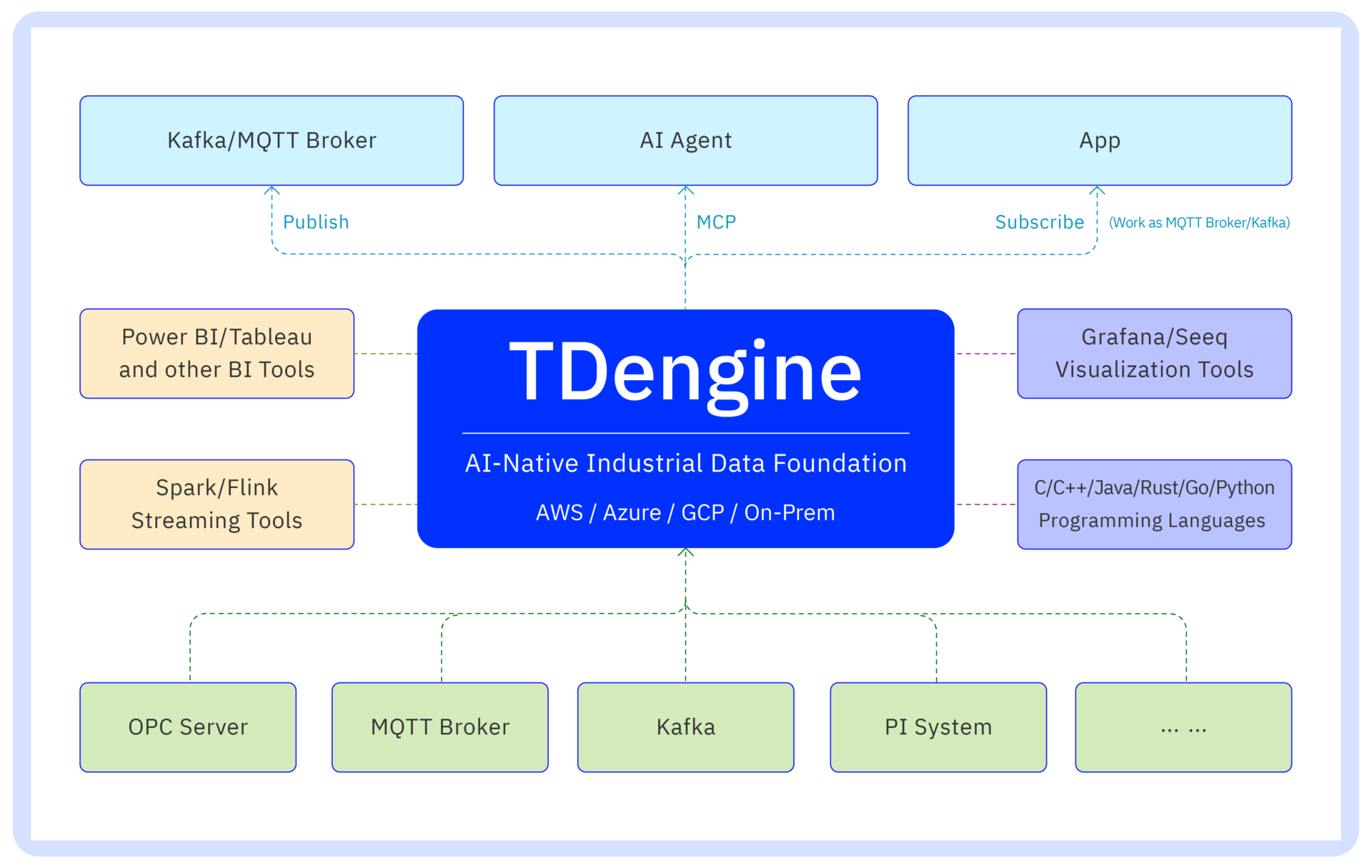
Furthermore, TDengine provides flexible, built-in tools to export data into open formats such as Apache Parquet or CSV, ensuring that information collected and stored within TDengine can be easily shared with other analytics systems or long-term archives. Parquet support in particular allows enterprises to move large volumes of time-series data efficiently into data lakes or object storage for batch analytics, machine learning, or compliance retention. There are no proprietary file types or conversion utilities to manage, and no additional licensing required to extract your own data. In essence, TDengine gives you complete freedom to store, process, and move your time-series data wherever it creates the most value.
PI System’s extensibility depends heavily on its own ecosystem. The AF SDK and Web API offer rich functionality, but they keep you anchored to the same vendor stack. To connect with external cloud services or data platforms, many users rely on AVEVA CONNECT data services, third-party middleware, or even custom scripts, which introduces additional cost and operational overhead.
More importantly, moving away from an established PI environment involves more than extracting historian data. While PI System now offers multiple APIs, integration services, and cloud connectivity options, existing AF models, calculations, dashboards, and downstream applications may still require significant mapping, rebuilding, and validation. These dependencies can make a full historian replacement complex and time-consuming, even when the underlying data is accessible. As a result, organizations that have accumulated years of operational data inside PI System often find themselves effectively locked in, facing high migration costs and significant engineering effort if they ever choose to move to another solution.
For a breakdown of the PI components and workflows involved, see our PI System Replacement Coverage Matrix.
The Hidden Cost of Lock-In
Vendor lock-in isn’t a technical constraint but a strategic one. Every proprietary dependency increases your reliance on existing vendors and decreases your flexibility to innovate or optimize costs as your business evolves. Want to try out a cutting-edge app or data service? If your vendor doesn’t provide a connector, you’re essentially out of luck. Once your data is locked inside a closed system, even simple changes, like adopting a new analytics tool or shifting to a cloud platform, can become time-consuming and expensive at best and impossible at worst. In the end, what should be a technology decision often turns into a business negotiation.
With TDengine, you avoid those limits entirely. Your data remains open, portable, and interoperable from day one. You can easily export data from TDengine to external systems if you decide to migrate in the future. And for organizations that already rely on PI System, TDengine even provides a built-in PI System connector, allowing you to ingest historical and real-time PI data into TDengine for validation and further analysis.
Conclusion
TDengine’s mission is simple: to make data accessible, affordable, and valuable. That means no hidden barriers, no closed formats, and no vendor lock-in. You decide where your data lives, how it’s used, and who gets access to it.
PI System has long been trusted across industries, but its tightly coupled ecosystem often makes data freedom difficult to achieve. If your future depends on openness and agility, TDengine gives you the power to keep your options open and your data fully in your hands.


