Highlights
-
Scaled to support 100,000+ connected devices, millions of data points with high-frequency ingestion
-
Stores 1.8 trillion time-series records (3 years of data)
-
Dataset compressed to 30% of original size

As a major manufacturing facility within China Tobacco, Kunming Cigarette Factory plays a key role in large-scale cigarette production in Yunnan Province, one of the world’s leading tobacco-growing regions. China Tobacco produces over 2 trillion cigarettes annually and generates more than $200 billion in revenue, reflecting the immense scale of its operations. Known for producing the flagship Yunyan brand, the factory operates complex, data-intensive production lines. In recent years, it has focused on modernizing its systems to improve stability, scalability, and real-time data processing across its core operations.

Background and Challenges
As the MES at Kunming Cigarette Factory was expanded and used in more applications, issues such as poor system stability and frequent anomalies in the data acquisition system began to emerge. These challenges are mainly reflected in the following aspects:
High Maintenance Costs and Limited Scalability
The existing Wonderware platform operates on an annual maintenance fee model, with pricing based on components and licensing tiers. It does not support perpetual licensing, and software upgrades require additional fees, resulting in high overall costs. Due to the use of an older version, some technical issues cannot be resolved in a timely manner, affecting system stability and production efficiency, and limiting the company’s ability to innovate in digitalization and intelligent manufacturing.
- Low Deployment and Release Efficiency: The Wonderware platform uses a traditional client-server architecture, requiring dedicated client installations. This leads to low deployment and configuration efficiency and limited distributed capabilities. When system updates are needed, each server and operator station must be updated individually, resulting in a heavy maintenance burden and slow response times.
- Limited Data Point Capacity: Currently, the system needs to collect and store over 300,000 data points. However, the historical data storage capacity of Wonderware is limited and cannot support future large-scale data analytics and digital transformation needs, becoming a bottleneck for further development.
- Limited External Interfaces: The system’s interface design lacks flexibility. When the number of client connections or access requests increases, system resources can easily become insufficient. This directly impacts the performance of real-time data ingestion and querying, reducing overall data processing capability.
Benefits of TDengine
To address the limitations of the traditional architecture in terms of cost, performance, and scalability, the MES system required a more efficient and flexible data foundation to support the growing volume of production data and the demand for intelligent upgrades. After in-depth evaluation and testing, TDengine was selected as the core data solution, with its advantages reflected in the following areas:
- Controlled Costs with Sustainable Upgrades: TDengine offers both perpetual licensing and subscription-based models. During the license period, if hardware upgrades or changes are required, software licenses can be migrated accordingly. This protects customer investment and reduces the total cost of ownership.
- High Stability with Elastic Scalability: TDengine features a mature distributed architecture that supports online scaling (both scale-out and scale-in). This significantly enhances system stability and flexibility, while enabling more efficient deployment and simplified operations and maintenance.
- Efficient Storage with Outstanding Performance: TDengine leverages columnar storage and advanced compression algorithms to greatly reduce storage footprint. With high ingestion throughput, it can easily handle high-frequency data writes and support data collection and storage at the scale of millions of data points.
- Rich Interfaces and Strong Compatibility: TDengine provides multiple access methods, including native connectors, REST APIs, and WebSocket support. It is compatible with mainstream programming languages such as Java, Python, C/C++, C#, and Go, and offers strong concurrency capabilities to meet real-time query and system integration requirements.
TDengine Implementation in Practice
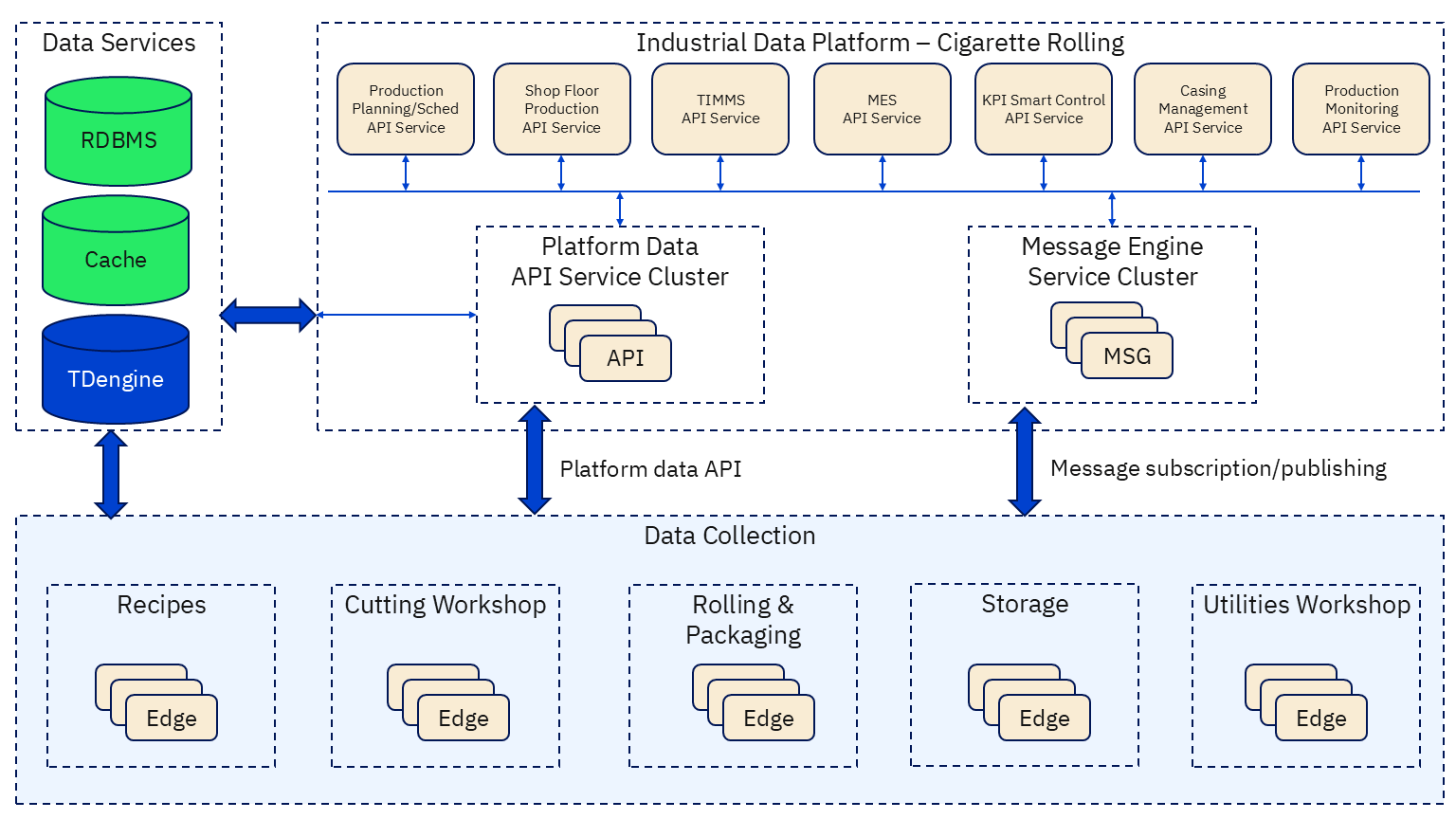
A three-node TDengine cluster was deployed for the MES to store equipment data collected by the SCADA system as well as environmental monitoring data from another system. After the migration from Wonderware to TDengine, both data processing capacity and system stability were significantly improved, providing stronger support for core operations such as production and environmental monitoring.
In terms of data modeling, the factory adopted a “one table per device” approach to store real-time data from production equipment, including cigarette making machines, packaging machines, filter rod forming machines, cutters, and casing machines. To date, more than 100,000 devices have been connected, and the number continues to grow. The data supports both real-time queries of key process parameters (such as moisture and temperature) and analytical use cases, including shift-based production output and rejection analysis, providing reliable data support for production management.
The new cluster consists of three physical servers, each configured as follows:
- CPU: 64 cores
- Memory: 128 GB
- Storage: 20 TB
During database setup, a three-replica strategy was adopted to ensure data redundancy and high availability. After the smooth migration of historical data, both the data ingestion programs and upper-layer application systems were successfully switched over.
Results
At present, the TDengine cluster has successfully ingested data from over 100,000 data points collected by the SCADA system. It stores three years of historical data, totaling 1.8 trillion records, while utilizing only 30% of the total storage capacity, indicating that it can support data retention for an estimated 8 to 10 years.
The cluster’s storage capacity can be dynamically scaled as needed to accommodate future growth in device data points. This project has validated TDengine’s suitability for handling massive time-series data in the tobacco industry, providing a reusable technical approach for digital transformation across the sector.
Future Plans
The current system adopts a narrow-table model, which simplifies data ingestion and management. However, in practical query scenarios, a wide-table, multi-column model is more convenient, especially for cross-point and cross-table analysis. Under the current model, such queries require complex JOIN operations and multiple data merges, resulting in inefficient timestamp alignment and noticeable query latency. As a next step, the factory plans to leverage the virtual table feature in TDengine TSDB to more efficiently support the growing demand for query and analytical workloads.
To enhance its data infrastructure further, Kunming Cigarette Factory is planning to transition to TDengine Historian as a unified platform for operational data storage as well as visualization and advanced analytics. In addition to the features provided by TDengine TSDB the factory aims to enable more intuitive, real-time visualization of production data while laying the foundation for AI-driven applications such as predictive analysis and intelligent process optimization. This upgrade is expected to improve decision-making efficiency, strengthen operational visibility, and support the next phase of data-driven manufacturing.