
The End of Traditional Industrial Applications
For decades, industrial software has been built around applications. SCADA systems, MES, historians, dashboards, and analytics tools are all designed as standalone systems, each with its own interface, data model, and workflow. Users are expected to learn these systems, navigate their interfaces, and adapt their processes accordingly.
This model has worked for a long time, but it comes with fundamental limitations. Applications are inherently rigid because they are designed in advance, with predefined features, workflows, and user experiences. When requirements change, the software must be modified, extended, or replaced, which is often slow and costly.
Many industrial systems still reflect an earlier generation of software design. It is not uncommon to see interfaces that feel outdated, with some systems still relying on Windows desktop clients rather than modern browser-based architectures. This is not just a user experience issue, but a direct reflection of how these systems are built.
Their functionality, workflows, and interfaces are tightly coupled, making them difficult to change. Even small adjustments — such as modifying a dashboard or adapting a workflow — often require deep system knowledge or vendor support. In environments where processes evolve continuously, this tight coupling makes systems slow to adapt and limits how quickly organizations can respond to new requirements.
From Applications to AI Agents: A New Interaction Model
AI introduces a fundamentally different way to interact with industrial systems. Instead of navigating predefined applications, users can interact with AI agents directly, using natural language to express intent and obtain results.
This shift goes beyond convenience and changes the role of software itself. Users no longer need to open dashboards, configure reports, or design workflows step by step. They can simply ask questions and receive insights, with the system translating intent into queries, analyses, and actions.
At the same time, it is now easier than ever to deliver customized applications for specific scenarios. With AI-assisted coding, a temporary dashboard, a diagnostic workflow, or a tailored operational view can be generated quickly and refined continuously. What used to require weeks of development can now be achieved in a much shorter time.
As a result, applications are no longer static systems. They become dynamic layers that can be created, adapted, and even discarded once the task is complete. This significantly reduces the cost and time required to build and maintain software, while also changing how we think about its role.
Applications are no longer long-lived assets, but flexible and disposable layers on top of something more fundamental.
The Real Foundation: Industrial Data in the AI Era
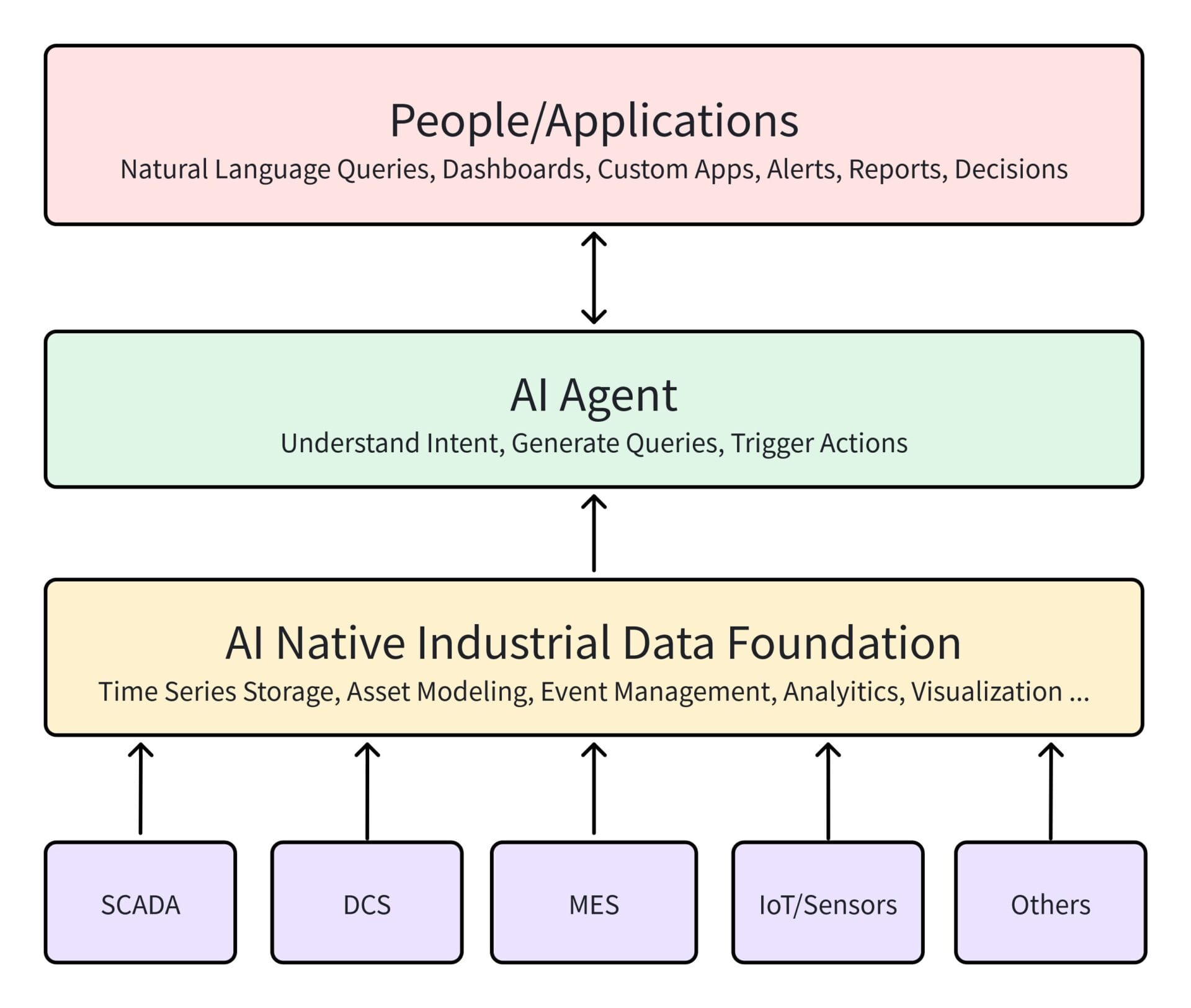
If applications become dynamic, then what remains stable is data. Industrial data, collected from equipment, processes, and operations, becomes the core asset that all applications, analytics, and AI systems depend on.
However, raw data alone does not create value. What makes industrial data meaningful is context, which connects individual signals to assets, processes, and events. Without this layer of contextualization, data remains fragmented and difficult to interpret, limiting its usefulness for both humans and AI.
Contextualization transforms data into a structured representation of operations. It organizes signals within asset hierarchies, relates them to operational conditions, and captures how systems behave over time. This is what allows data to reflect not just measurements, but real operational understanding.
Unlike applications, data accumulates continuously. It captures operational history, system behavior, and organizational knowledge, and this accumulation, combined with proper context, is what gives it long-term value. In the AI era, this distinction becomes even more important, because applications and interfaces may change frequently, while the data foundation remains persistent.
This persistent, contextualized data foundation is what organizations truly own, and it is the layer that connects past operations with future intelligence.
Designed for AI Agents and Continuous Evolution
If the data foundation becomes the core asset, then its design becomes critical. In the AI era, it is no longer sufficient to build systems for human users alone. The data foundation must be designed for AI agents from the beginning.
AI agents rely on structured, contextualized, and machine-readable data to operate effectively. They need to understand relationships between assets, interpret events, and work with data that carries clear semantics. Without this, they may generate responses, but those responses will lack operational meaning.
This requires the system to expose not only data, but also capabilities. Querying, analytics, and higher-level functions should be accessible through open interfaces, allowing AI agents to interact with the system directly rather than through predefined applications. In this sense, the data foundation becomes a platform that AI agents can understand, operate on, and build upon.
At the same time, the data foundation must support continuous evolution. AI technologies are evolving rapidly, and new models, tools, and interaction patterns emerge constantly. Applications can be rebuilt or replaced at any time, but the underlying data foundation must remain stable while enabling change.
This requires a clear architectural separation between layers. The upper layer, including applications, interfaces, and workflows, can evolve continuously, while the lower layer, the data foundation, must remain consistent, scalable, and open. It must allow new technologies to integrate without friction, while preserving the integrity and continuity of the data.
A data foundation that is not designed for AI agents will become a bottleneck. A data foundation that cannot adapt to continuous evolution will quickly become obsolete. Only when both requirements are met can industrial systems fully realize the potential of AI.
Closing Thought
Applications will change, interfaces will change, and even the way we interact with systems will continue to evolve. These changes are inevitable as technology advances and new capabilities emerge.
What will not change is the importance of the data foundation. It is the one asset that persists, accumulates value over time, and supports every layer built on top of it.
In the AI era, it is not enough to have a data foundation. It must be designed for AI agents from the ground up, so that it can support not only today’s applications, but also whatever comes next.


