
Cane sugar processing is a highly continuous, tightly coupled industrial process with extremely high requirements for operational stability. Raw materials are subject to significant natural variability due to factors such as variety, maturity, sugar content, and fiber content. Combined with the short crushing season and a tightly paced production schedule, any unplanned shutdowns or loss of control over key parameters can result not only in output losses, but also in potentially irreparable economic and social impacts, particularly those affecting upstream agricultural production of sugarcane and sugar beets.
Most sugar mills have long relied on experience-driven process adjustments and data management approaches that are segmented by production stages and isolated from one another. Over time, the limitations of these traditional practices have become increasingly apparent. While experience is valuable, it is difficult consistently to transfer and efficiently to replicate across different shifts and personnel. Meanwhile, although production data is continuously generated, it is scattered across multiple systems and records, making integrated analysis difficult and preventing effective support for sustained, fine-grained control aimed at stable output, quality improvement, and cost reduction. This has become a broad industry consensus: relying solely on traditional methods is no longer sufficient to meet the growing demands for stability and process controllability in modern production operations.
Industry Challenges
The challenges outlined below are common issues widely found across the sugar industry.
First, the production process involves a long chain with many stages, from pretreatment, crushing, clarification, evaporation, and crystallization to centrifugation, drying, and packaging. Data from these stages is often scattered across different systems and records with no unified perspective, making it difficult to establish end-to-end production monitoring and analytical capabilities.
Second, in terms of process and quality control, parameter adjustments have long relied on manual, experience-based judgment. Many abnormalities are only detected after final quality indicators have already deviated from targets. The lack of continuous, process-level analysis and monitoring makes it difficult to implement early warnings or proactive intervention.
Finally, when it comes to material and sugar loss management, the industry has long lacked effective tools for clear and systematic analysis. Losses are distributed across multiple stages — filter mud, molasses, wash water, sugar run-off, and so on — and are mostly estimated based on experience. As a result, it is difficult to form a structured and comparable “sugar loss profile,” which significantly constrains ongoing optimization of sugar yield efficiency and overall operational performance.
It is these widespread pain points — lack of visibility and lack of control — that have driven the sugar industry to rethink its production management approaches, and have caused platforms such as TDengine IDMP, which integrate production data and process management, to become an increasingly important choice for enterprises pursuing digital transformation and improved operations.
Putting Sugar Production on a Data-Driven Foundation
At sugar mills during the crushing season, it is common for operators to struggle with data being successfully collected but still unusable. Raw material characteristics fluctuate daily, production processes are long and complex, and relevant data is often scattered across local DCS systems, standalone equipment systems, and manual logbooks. Operators rely heavily on experience-based monitoring, while data flows poorly between upstream and downstream systems. As production speeds up, potential risks and anomalies are easily buried in overwhelming streams of information.
High Light Automation Engineering’s recent decision to introduce TDengine into their infrastructure was designed to transform dormant data into actionable capabilities that directly support production decision-making and operational optimization. Starting with data acquisition and ingestion in TDengine TSDB, the company’s data platform then enables data governance, business scenario modeling, and AI-driven analytics in TDengine IDMP to establish an industrial data management system that is production-oriented and designed to support process optimization and stable operations.
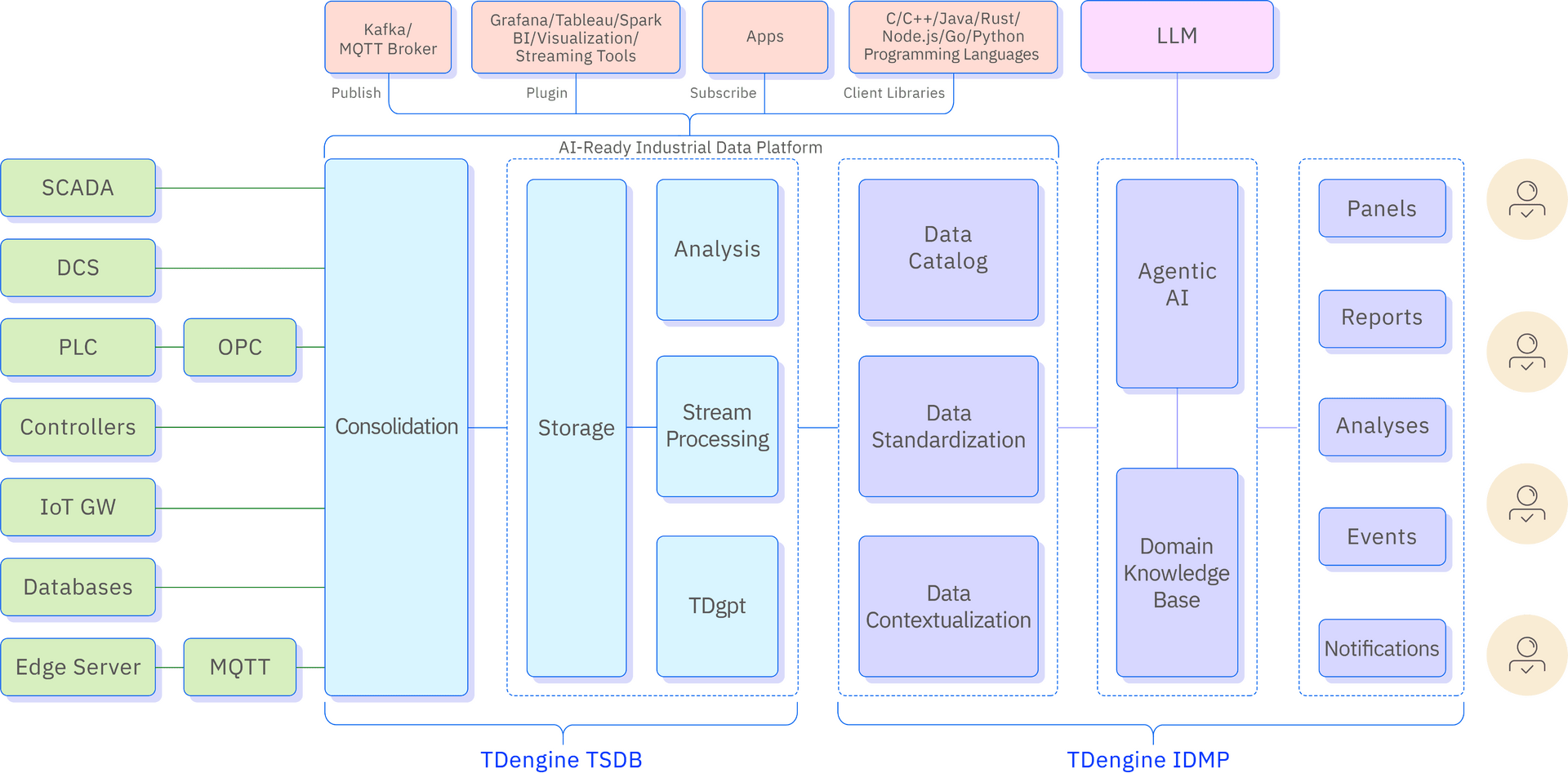
Data Acquisition
Prior to implementing TDengine, the situation on the ground at High Light’s customers’ sugar mills was a familiar one across the industry: the volume of data was not small, but it was highly fragmented. Local DCS systems and standalone systems for various pieces of equipment served only localized monitoring needs; there had long been a lack of unified and efficient data output for data analysis, centralized management, and intelligent applications.
To address this, High Light built an independent data acquisition and aggregation channel above the centralized control layer without affecting the stable operation of existing control systems. The company deployed a TDengine TSDB instance at each plant, using its built-in zero-code data connectors to read real-time process data from DCS servers via standard OPC interfaces, ensuring stable acquisition and ingestion of key production data. At the same time, a centralized TDengine TSDB instance was deployed in the enterprise data center to aggregate and manage operational data from all plants in a unified manner, laying the foundation for subsequent cross-site analytics and collaboration.
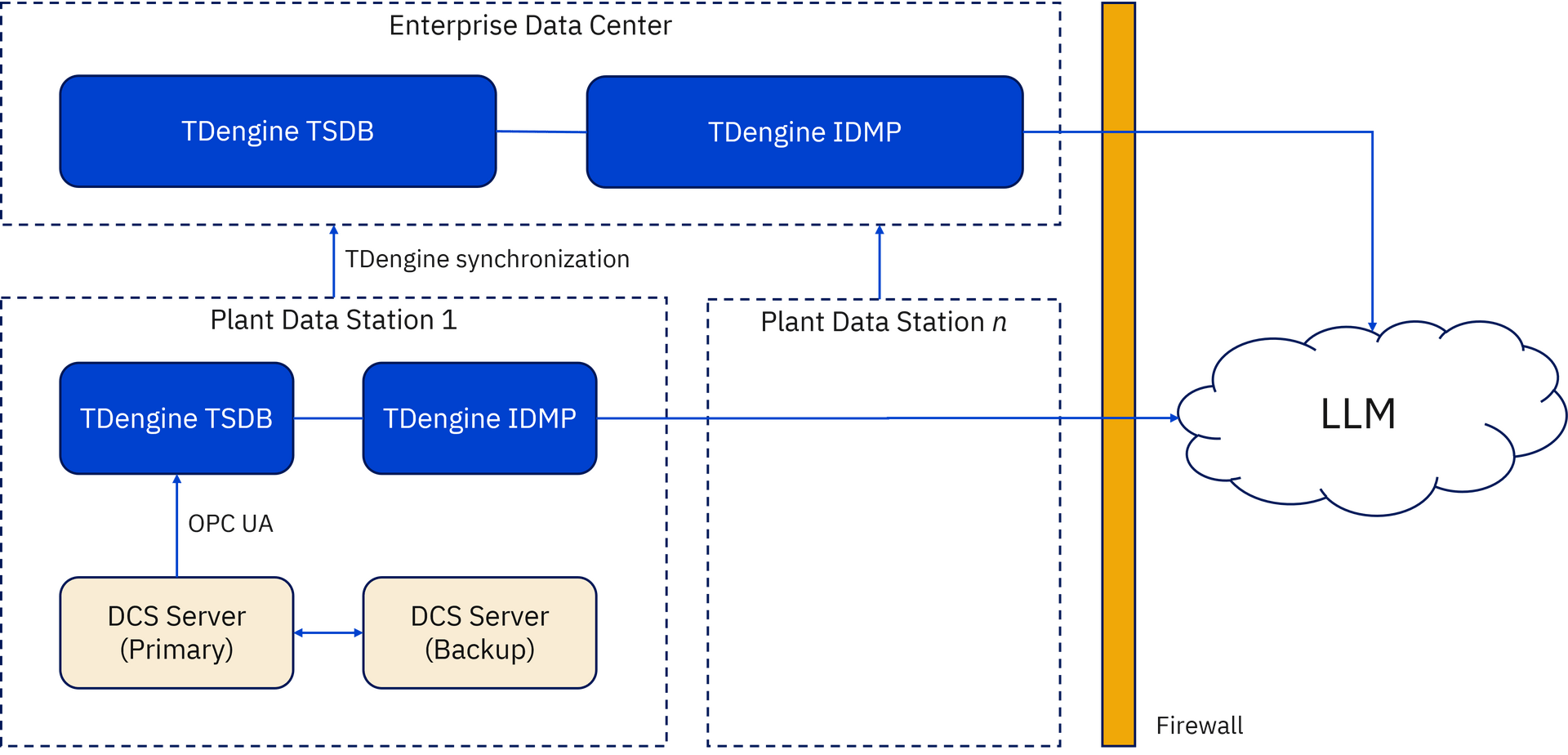
This architecture preserves the mature and proven operational frameworks of DCS and SCADA systems while establishing a unified and scalable data acquisition and aggregation layer on top of them that enables data governance, business scenario modeling, and AI applications.
Data Analytics
At the data analytics layer, the platform leverages the high-performance time-series data management capabilities of TDengine TSDB to enable unified processing of real-time and historical data. Combined with time-series foundation models for forecasting and anomaly detection, it continuously analyzes production processes and equipment operating conditions.
By building time-series models for key process parameters and operational indicators, these foundation models can identify normal operating patterns, predict trend changes, and promptly detect and alert on abnormal fluctuations that deviate from normal ranges, helping enterprises identify potential risks in advance.
This capability shifts production management from experience-driven, retrospective analysis to data-driven trend forecasting and anomaly detection, providing more timely and reliable data support for stable process operations, improved equipment reliability, and informed operational decision-making.
Data Catalog
Data acquisition addresses the questions of “whether the data exists” and “whether it can be processed,” whereas the data catalog addresses a different question: “whether the business can actually use it.”
TDengine IDMP does not force everyone to view data from a single perspective. Instead, it allows different departments to organize data according to their own business logic. Production teams can structure data around process flows, organizing it by procedures, stages, and key parameters, while equipment management teams can build catalogs based on equipment types and operating conditions, focusing on reliability and maintenance. The same underlying data can be repeatedly referenced from multiple business perspectives.
For business users, finding data no longer means searching through disparate systems, but simply opening the catalog. Clearly defined structures and entry points enable data to be reliably accessed and continuously analyzed.
Data Standardization
In industrial systems, data standardization is not merely a matter of compliance, but a foundational engineering requirement that directly determines whether results can be trusted. The aerospace industry has seen major incidents caused by inconsistent units, a lesson that is often cited not by coincidence, but because it reveals a universal rule: when data definitions are inconsistent, systems may run normally while producing entirely incorrect conclusions.
The same risks exist in sugar production. As an example, DCS systems typically collect clarified juice flow data as volumetric flow (m³/h), while some legacy systems or manual records use mass flow (t/h). Each definition works fine within its own system, but once cross-system analysis is required — such as material balance calculations, capacity evaluation, or energy accounting — the problem becomes apparent. The same clarified juice flow, when used in different systems, can yield completely different results.
With TDengine IDMP, such issues no longer rely on operators remembering the differences through experience. Instead, standardized modeling at the data layer eliminates ambiguity at the source, ensuring that “one ton of sugar” has a single, well-defined, and reusable calculation method across the system.
Turning Veteran Know-How into System Rules
In day-to-day production, many critical definitions have already become industry-wide consensus, yet they have long existed only in experience and habit. Through its element template mechanism, TDengine IDMP transforms this unwritten consensus into executable and enforceable system rules.
Taking clarified juice as an example again, TDengine IDMP defines it in a unified and standardized way at the model layer, clearly specifying all associated attributes and applying consistent constraints on each attribute’s name, business meaning, data type, unit of measure, and usage definition. For clarified juice flow, the model explicitly defines its business semantics, standard unit, process calculation logic, and whether it is subject to core rules such as material balance and capacity analysis.
In this way, each class of process objects and indicators has a single, unambiguous definition within the system, fundamentally eliminating issues such as “same name, different meaning” or “same value, different calculations.” This provides a consistent and reliable data foundation for cross-system analytics and long-term stable operations.
Automated Unit Conversion
While enforcing unified standards, TDengine IDMP also fully accounts for the complexity of existing systems. At the attribute template level, the platform introduces automatic unit recognition and derivation.
Continuing with the clarified juice flow example, when data comes from DCS systems, the platform identifies the unit as volumetric flow (m³/h); when it comes from legacy systems or manual records, it is recognized as mass flow (t/h). During calculations or analysis, TDengine IDMP automatically derives and performs the required unit conversions based on the target attribute’s defined unit, ensuring consistent calculation logic and results.
This entire process requires no manual intervention and does not rely on individual assumptions or experience. As a result, data from different sources and with different definitions can safely and reliably participate in analysis under a unified model, providing stable support for material balance calculations and operational decision-making.
Data Contextualization
The sugar industry realizes that data without context is nothing more than a series of numbers; only when placed within specific process scenarios does data truly become meaningful.
During the crushing season, conditions on the production floor change rapidly. One day, pH levels in the clarification stage may fluctuate; the next, molasses purity may appear abnormally high; days later, discrepancies may emerge between actual sugar yield and theoretical values. These issues are not inherently complex, yet traditional analysis methods are often extremely time-consuming. Typically, business personnel propose initial hypotheses based on experience, after which technical staff search across multiple standalone systems to locate relevant data points and collect the necessary information. Even once the data is gathered, additional time is spent repeatedly verifying time ranges and calculation definitions. By the time this cumbersome process is completed, several days may have already passed.
At its core, the problem rarely lies in a lack of expertise. Rather, it stems from the absence of contextual organization of the data itself. Business users often do not know which systems hold the required data or whether it can be directly used, while technical staff struggle to understand how the data should be connected and analyzed from a process perspective, or what business logic links them together. This disconnect between data and business makes efficient analysis and decision-making difficult to achieve.
A Critical Link Between Business and Technology
With the introduction of TDengine IDMP, sugar enterprises can enable data to become a common language between business and technology.
By enriching data with unified and clearly defined business semantics, TDengine directly links each data point to specific production processes. Every data item is explicitly associated with a particular process stage (e.g. clarification, evaporation, or crystallization), tagged with the type of process mechanism it reflects (reaction intensity, extraction efficiency, or recovery loss), and clearly defined in terms of the business scenarios in which it applies (quality monitoring, material balance, anomaly analysis, or process optimization).
On this basis, the platform also establishes a standardized technical metadata layer to uniformly manage data sources, units of measurement, and valid value ranges. As a result, where data comes from and how it is calculated becomes transparent and traceable. When performing analysis, calculations, or configuring alerts, the system can automatically ensure consistent definitions and logic, avoiding discrepancies caused by differing interpretations.
The core value of this step lies in transforming the implicit knowledge and shared understanding that once existed only in the experience of veteran operators into explicit, reusable system rules, laying a solid foundation for knowledge transfer and scalable application.
Self-Service Business Analytics
Once data has been fully contextualized, the way sugar enterprises conduct business analysis fundamentally changes from a model heavily dependent on IT support to one centered on self-service analysis by business users. The system no longer presents fragmented point IDs or underlying data structures. Instead, data and functions are organized around process scenarios familiar to business users, such as clarification stability, material balance, and sugar yield efficiency.
Taking the clarification stage as an example, process engineers working within the clarification stability scenario can directly select key indicators such as pH, turbidity, and color value, and freely build trend comparisons and correlation analysis dashboards through simple drag-and-drop operations. These visualizations can be used to assess in real time whether reaction conditions are deviating from normal ranges. The entire process requires no modeling or data extraction requests to the IT department, and the analytical logic remains closely aligned with on-site realities. As a result, business users can make independent judgments and decisions based directly on data flows.
This scenario-driven analytics model significantly lowers the barriers to data usage and reduces technical complexity, enabling process personnel to use data tools more proactively and confidently, and helping data analysis become an integral part of the daily operational feedback loop.
Improved Responsiveness
When business analytics becomes self-service, the most immediate impact for sugar enterprises is a marked improvement in response speed. In the past, moving from anomaly detection to analytical conclusions often required multiple handoffs and processing steps that could take days. By the time conclusions were reached, the optimal window for process adjustment might have been missed and problems might already have escalated.
With TDengine’s data contextualization, business users can complete data retrieval, comparative analysis, and hypothesis validation within a single shift. For example, when pH values in the clarification stage begin to show sustained deviation, the system can automatically aggregate relevant indicators within the corresponding business scenario, enabling process engineers to immediately decide whether adjustments to chemical dosing or process parameters are required. Similarly, when actual sugar yield deviates from expectations, the root cause can be quickly identified, whether it stems from upstream extraction efficiency, clarification losses, or downstream recovery performance.
This means that issues can be identified and addressed before they escalate, allowing production operations to gradually shift from reactive response to proactive prevention and control.
Overall, data contextualization enables sugar enterprises to activate data for business use. Production management no longer relies heavily on individual experience or ex post facto analysis, but instead evolves toward a fast decision-making mechanism driven by data and anchored in business scenarios, making operations more stable, efficient, and controllable.
Zero-Query Intelligence
The true value of AI does not lie in replacing human thinking, but in having the relevant information and insights prepared before a problem is explicitly raised.
In the past, central control systems in the industry largely played a passive role. Which indicators to monitor and how to perform correlation analysis depended entirely on the experience of the personnel on duty. Process engineers had to recall key indicators from memory, locate data points, and adjust analysis time windows on their own. Newly rotated teams often struggled to get up to speed quickly, and when experienced veterans were not present, much of the implicit process logic and judgment could not be effectively reused.
After introducing TDengine IDMP and completing data contextualization, the role of AI changes fundamentally. Instead of passively waiting for instructions, it actively identifies the current production state based on an understanding of process semantics and business context, and dynamically recommends monitoring views and analytical content best suited to the situation. In doing so, the system helps guide attention and enables personnel with varying levels of experience to focus more quickly on critical issues, transforming expert knowledge into a sustainable, reusable system capability.
A Real Scenario in the Clarification Stage
Traditionally, monitoring in the sugar industry was often limited to observing a few real-time trends of key parameters, making it difficult to determine systematically whether the current operating conditions were within a normal range, or whether trends were beginning to deteriorate.
Now, TDengine IDMP’s AI automatically recommends a complete set of monitoring panels that align with the logic of the clarification process. In the clarified juice scenario, the system prioritizes the following views:
- The latest clarified juice pH value over the past hour, enabling a quick assessment of the current reaction state
- The hourly average clarified juice turbidity over the past day, helping users observe short-term stability
- The average clarified juice reducing sugar over the past week, along with daily aggregated trends, used to evaluate the impact of clarification performance on sugar loss
These views are not generic templates; they are generated because the system understands that these indicators represent the most critical and business-relevant data combination for the clarification stage.
Proactive Monitoring and Analysis
Before the introduction of TDengine IDMP, monitoring the clarification stage in the sugar industry relied heavily on human experience. Central control dashboards were constantly moving, and process engineers had to stare at trends for long periods, relying on their intuition to decide whether something felt off. After adopting TDengine IDMP, data contextualization is already in place, and AI no longer waits for questions from users. Instead, it proactively recommends real-time event monitoring and analysis related to clarified juice, using real-time analytical alerts to call people over at critical moments.
In the clarified juice scenario, the system can automatically recommend analyses such as:
- When the outlet temperature of the clarified juice heater exceeds 105°C and remains above this threshold for more than 5 minutes, a primary alert is triggered immediately, along with the average outlet temperature for that period, clearly indicating an overheating risk.
- For clarified juice turbidity, the system performs anomaly detection every 5 minutes using a k-sigma algorithm with a 3× standard deviation threshold. Once abnormal fluctuations are detected, the maximum turbidity value is reported directly, helping users quickly assess the severity of the anomaly.
- The system also recommends a rolling calculation every 10 minutes of the average flow rate over the previous 30 minutes, assisting in determining whether the current load has changed.
These methods were often known only by a small number of highly experienced process engineers, and could be applied only through continuous human monitoring of data and repeated manual comparison and analysis. Today, with the introduction of TDengine IDMP, this experience and logic are captured by AI and solidified into continuously operating, automated system capabilities. As a result, production management gradually shifts to a collaborative mechanism of system alerts with human confirmation, enabling anomalies to be identified earlier and process adjustments to be carried out more promptly. This is the most direct value that TDengine IDMP brings to sugar production management: making tacit knowledge explicit, and transforming individual experience into sustainable, reusable system intelligence.
For the sugar industry, the most significant change is that when operations are normal, data does not get in the way, and when anomalies occur, nothing is missed. Issues are identified earlier and adjustments can be made more promptly.
Application Outcomes
As TDengine is progressively deployed and applied across production sites, sugar enterprises are expected to achieve systematic improvements in production management and process control. Centered on the three core domains of production, process, and equipment, the overall solution enables data to move beyond the system layer and become continuously embedded in daily operations and management decision-making.
End-to-End Production Monitoring
By applying unified data asset modeling to the sugar production process, TDengine enables full-lifecycle data acquisition and centralized monitoring from pretreatment all the way through to drying and packaging. Data that was previously siloed across individual process stages is integrated to form a continuous and complete production view. Key process parameters and operating conditions are presented in a consolidated manner, providing clear and consistent support for on-site management, production scheduling, and anomaly detection.
Material Loss Analysis
Focusing on process workflows and material flows, the TDengine-based data platform introduces systematic data analytics and material balance methods to structurally analyze sugar losses across key stages. Issues that previously relied largely on experience-based judgment are transformed into quantifiable and comparable results. Production, process, and equipment conditions become more transparent to management, providing a stronger data-driven foundation for process optimization and quality control decisions.
Real-Time Process Quality Monitoring
The TDengine-based platform establishes a continuously operating process quality monitoring system that tracks operating conditions across all production stages in real time and enables comparative analysis. This shifts the detection of process fluctuations from after-the-fact discovery to proactive, in-process control. By identifying process deviations and abnormal trends in a timely manner, the impact of fluctuations on product quality is effectively reduced, helping maintain stable production operations.
Process quality status becomes more transparent between the production floor and management, providing continuous and reliable data support for process adjustments and quality control, and effectively underpinning stable sugar production and consistent product quality.
Business Value
From an industry application and development perspective, the value of projects like this goes far beyond one-time system deployment or milestone acceptance. These projects establish a digital foundation that can evolve over the long term and continuously empower the enterprise. Through unified data standards and platform architecture, the sugar industry gains for the first time the capability to continuously perceive, systematically analyze, and sustainably optimize the entire production process, laying a solid groundwork for deeper management practices and intelligent applications.
In the short term, implementation of the platform effectively enhances production transparency and operational stability. Over the medium to long term, it is expected to grow into core infrastructure that supports stable output, quality improvement, cost reduction, and precise risk control for sugar enterprises.
Industry Significance
Applicable Enterprises
- Cane sugar producers seeking continuous improvement in management capabilities and long-term competitiveness
- Small- and medium-sized sugar mills at a critical stage of digital transformation
Key Prerequisites for Success
- A clear and unified understanding among management of digitalization goals and the value of data
- A relatively stable and continuous foundation of production and equipment data
Core Path
- Advance digitalization systematically with “process + materials + equipment” as the main framework
- Implement step by step at a pace of “make it visible → make it quantifiable → make it stable,” avoiding overly aggressive investment
- On the basis of a solid data foundation, steadily progress toward intelligent optimization and AI applications
Future Outlook
TDengine IDMP can establish a solid foundation for sugar enterprises in production data acquisition, centralized monitoring, and analysis, effectively supporting the day-to-day needs of process monitoring and quality analysis.
Building on this foundation, enterprises can look ahead to further introducing and strengthening the platform’s configuration capabilities, enabling more intuitive and graphical representations of process flows, equipment operating states, and key process parameters. This will drive production monitoring to evolve from data lists and charts toward comprehensive, process- and state-oriented visual control. By configuring key quality indicators and process constraints in a model-driven manner, mature process expertise can be solidified into automatically executable monitoring rules, enhancing early identification and proactive intervention for process deviations and quality risks, and better supporting the long-term, stable, and efficient operation of sugar production.


