
China Petroleum & Chemical Corporation (Sinopec) is one of the world’s largest integrated energy and chemical companies and a consistent member of the Fortune Global 500. The company operates across the full value chain, including upstream oil and gas exploration, refining, petrochemicals, and distribution. Sinopec produces hundreds of millions of tons of oil and gas annually and operates one of the largest refining capacities in the world, exceeding 300 million tons per year.
The oilfield described in this case study is the second-largest in Sinopec. It operates across a total licensed area of 15,405 square kilometers, with estimated resources of 2 billion tons of oil and 1.8 trillion cubic meters of natural gas. Proven geological reserves include 625.8 million tons of oil and 483.3 billion cubic meters of natural gas.
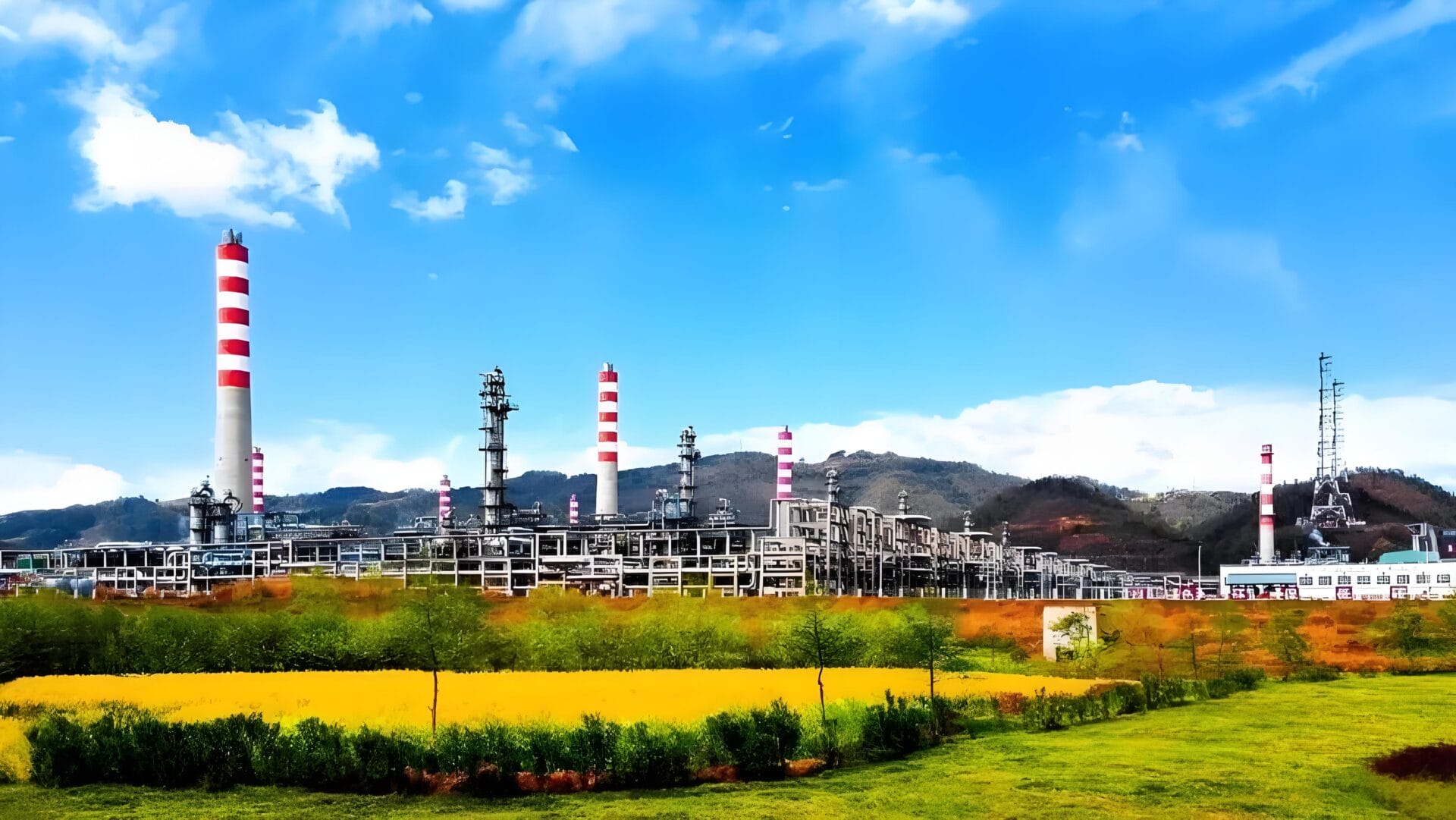
The oilfield relies on its Production Control System (PCS) as a core hub for ensuring safe operations and optimizing production. To address challenges such as high-concurrency write bottlenecks, high storage costs, complex real-time analytics requirements, and data silos across multiple business domains, TDengine was deployed in the data infrastructure, storing and managing data for core PCS modules and enabling real-time data synchronization from branch sites to headquarters.
Business Challenges
The PCS system covers multiple critical business domains, including oil production, water injection, gas storage management, and pipeline monitoring. Across the oilfield, tens of thousands of sensors and intelligent devices generate hundreds of thousands of time-series data records per second. And with the widespread adoption of IoT technologies and the acceleration of digital transformation, the number of connected devices and data types in the PCS system has grown exponentially. This massive volume of time-series data has placed significant pressure on the existing Oracle-based data architecture.
Under the original architecture, the system faced several key challenges:
- Write Performance Bottlenecks: Oracle databases are not designed for high-frequency time-series data ingestion. Under heavy concurrent insert workloads, I/O pressure becomes significant, often leading to write latency and even impacting the timely delivery of front-end control commands.
- High Storage Costs: Relational databases offer limited compression efficiency for time-series data, resulting in substantial storage consumption. To retain historical data over required periods, continuous investment in high-end storage infrastructure is needed, driving up both hardware and maintenance costs.
- Limited Real-Time Analytics Capability: Performing operations such as time-window aggregations and cross-device correlation analysis in Oracle requires complex SQL queries with low execution efficiency. Query response times often exceed several minutes.
- Rigid System Architecture: Different business modules (such as PCS and gas storage systems) store data independently, creating data silos. This makes it difficult to perform unified cross-domain analysis and extract broader business value.
These challenges have significantly constrained the oilfield’s progress toward digitalization and intelligent operations, making it essential to adopt a high-performance database purpose-built for time-series data.
Why TDengine Historian
Sinopec required a system that could deliver extremely high write and query performance, excellent data compression, strong SQL compatibility, high availability, and a cluster architecture that is easy to operate and maintain, while also integrating seamlessly with the existing IoT ecosystem.
After rigorous testing, TDengine Historian demonstrated decisive advantages in the following areas:
- Superior Performance: Under the same hardware conditions, TDengine achieved significant improvements in both write throughput and query speed compared to other solutions.
- Exceptional Compression: With a storage architecture purpose-built for time-series data, TDengine achieved a compression ratio of 1:10, significantly outperforming other tested alternatives.
- SQL Compatibility: The team’s existing SQL expertise could be directly applied, greatly reducing development and learning costs. It also enabled seamless integration with third-party tools via standard JDBC connections.
- Data Contextualization: TDengine enabled real-time ingestion and contextual modeling of data across geographically distributed oilfield assets, eliminating silos and allowing operators to correlate production, pressure, and flow data in a single system.
- Built-In Visualization and AI-Driven Insights: With integrated P&ID-style visualization, analytics, and zero query intelligence, TDengine allowed teams to monitor operations, detect anomalies, and access insights instantly without relying on multiple tools or manual query building.
System Architecture
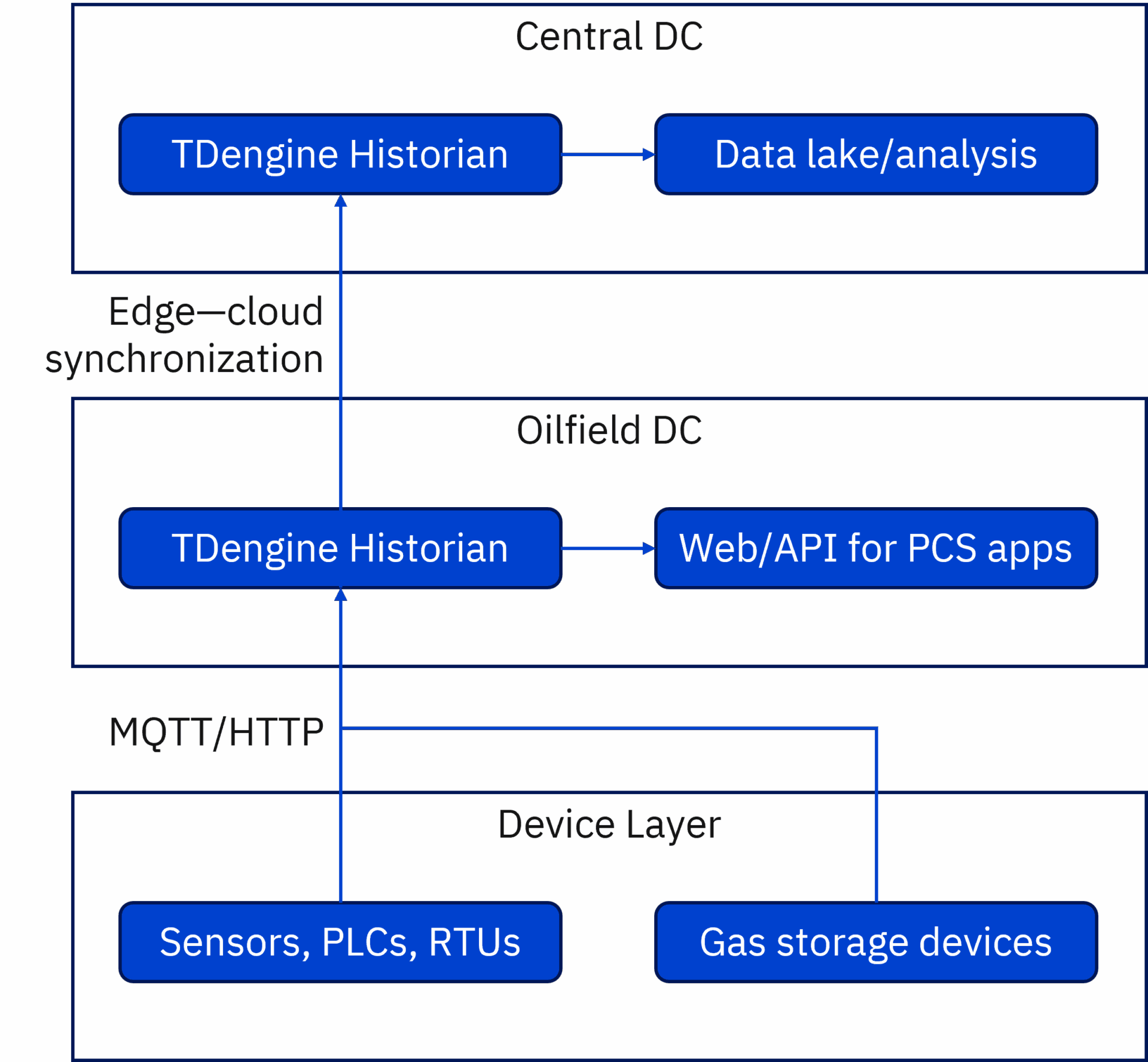
An edge-cloud synchronization model was used, with TDengine serving as the core data persistence layer and computation engine throughout the system.
Capabilities and Benefits
Data Ingestion and Real-Time Processing
A dual-track data ingestion strategy was created to support various business scenarios at the oilfield. For business data with flexible and frequently changing structures, such as gas storage operations, TDengine’s schemaless mode allowed the database to automatically create tables and significantly simplify data integration. For core PCS business data, which has a stable structure and more complex logic, traditional SQL-based ingestion was used to ensure precise control and high performance.
Key Benefits
- Breakthrough in Write Performance: TDengine’s write engine, purpose-built for time-series data, eliminates the I/O bottlenecks encountered with Oracle. The system can easily handle hundreds of thousands of concurrent data writes per second, reducing latency from seconds to milliseconds, and ensuring real-time monitoring and timely execution of control commands.
Data Synchronization and Distribution
To meet requirements for global data analysis, the project synchronizes selected tables and supertables from oilfield production sites to headquarters in real time, achieving unified data integration across operations. Data synchronization tasks are configured through a graphical interface in the database management web console.
Key Benefits
- Unified Data Aggregation: A two-tier edge—headquarters data architecture has been established, effectively addressing the need for centralized, global data analysis at headquarters while supporting localized data processing at branch sites.
- Reliable and Efficient Synchronization: TDengine ensures data consistency and reliability during synchronization, with minimal impact on the performance of the source cluster. Headquarters can access a real-time, unified view of enterprise-wide data, providing a solid foundation for strategic analysis and cross-regional benchmarking.
Data Query and Analytics
Business applications, real-time dashboards, and analytics systems can directly access TDengine via standard SQL, a RESTful API, or JDBC. This enables full use of built-in functions for efficient aggregation, interpolation, and downsampling. With the supertable model, unified query and analysis across devices and regions has become straightforward.
At the application layer, business systems, real-time dashboards, and alerting engines connect directly to the oilfield-side TDengine cluster, leveraging its real-time computing capabilities for fast data querying and analysis.

Key Benefits
- Query Performance Improvement: Typical query scenarios see significant performance gains. For example, time-window aggregations such as “average pressure per minute over the past hour at a water injection station” can be executed much faster and more efficiently.
- Breaking Down Data Silos: Using the supertable model, data from similar equipment (e.g., pumps) across different oil production plants and business domains (such as oil production and water injection) can be unified under a consistent schema. This enables cross-domain and cross-region analytics, unlocking new opportunities for coordinated production optimization.
- Enhanced Real-Time Analytics: Millisecond-level query response times make real-time dashboards, interactive analysis, and instant decision-making feasible and significantly improving the responsiveness of production scheduling and emergency operations.
Data Storage and Compression Module
TDengine is purpose-built for time-series data, leveraging columnar storage and specialized compression algorithms to enable high-throughput ingestion and efficient storage of massive data points. This approach not only significantly reduces storage footprint but also improves query performance.
Key Benefits
- Significant Reduction in Storage Costs: TDengine has proven highly effective at data compression, typically achieving ratios exceeding 10:1. For example, datasets that originally required around 50 TB of raw storage are reduced to approximately 4.2 TB with a single replica. Combined with tiered storage strategies, overall long-term storage costs have been reduced by more than 85%.
- Automated Storage Management: Tiered storage enables automated data lifecycle management, eliminating the need for manual archiving. While ensuring historical data remains accessible for queries, it also frees up expensive high-performance storage for active workloads.
Enabling Intelligent Oilfield Operations with a Unified Platform
With TDengine deployed as the core data infrastructure, Sinopec has moved beyond basic data collection and storage toward a more integrated and intelligent data architecture.

TDengine not only serves as the high-performance time-series data engine for the PCS system, but also provides the foundation for data modeling, real-time analytics, and operational visualization across the oilfield. By consolidating previously siloed systems into a unified platform, Sinopec is now able to support cross-domain analysis and enterprise-wide visibility.
Through this architecture, data from production, water injection, gas storage, and pipeline systems is standardized and contextualized, enabling more efficient monitoring and decision-making. Real-time dashboards, analytics workflows, and application systems connect directly to the TDengine platform, leveraging its millisecond-level query performance and built-in processing capabilities.
At the same time, the platform supports advanced data workflows such as real-time synchronization between edge sites and headquarters, ensuring that operational data is always available for both local control and centralized analysis.
By integrating these capabilities into a single system, Sinopec has effectively established a modern industrial data foundation that supports not only current operations but also more advanced, data-driven use cases.
This includes the ability to apply intelligent analytics, streamline operational workflows, and continuously optimize production based on real-time insights—without the need for additional systems or complex integrations.


