TDengine vs. Canary Labs
Be confident choosing the platform that will power your operations for the next decade. Below is a clean, accurate comparison of core capabilities across storage, data collection, modeling, analytics, visualization, distribution, security, deployment, integrations, and AI.
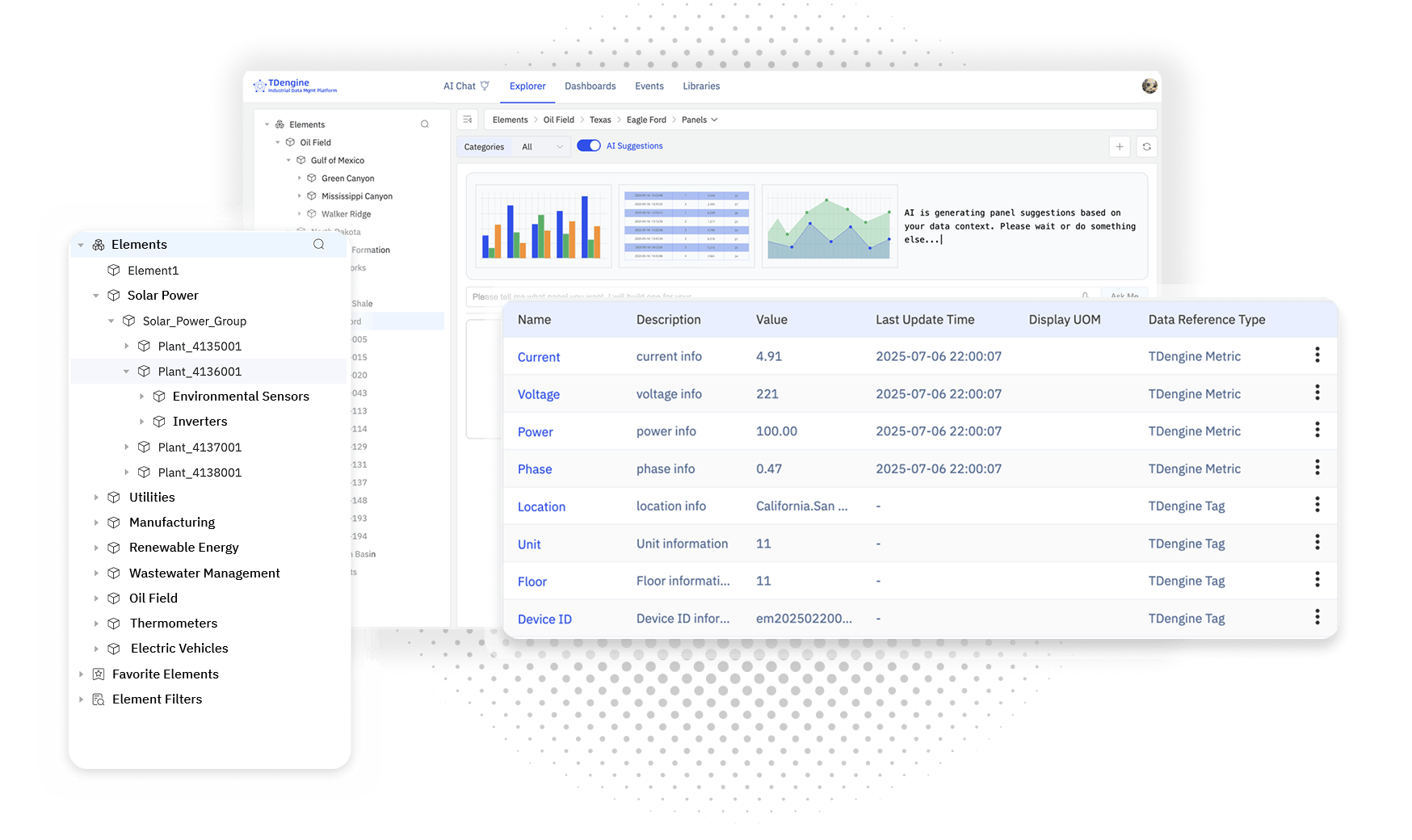
Why Teams Pick TDengine over Canary Labs

Proven industrial technology
Trusted by 1,000+ global customers; largest production deployment managing 50+ million tags for over three years

Richer data model
Element references to allow one device to belong to multiple trees; advanced data types like JSON, blob, and geometry

Open pipelines in & out
Native Kafka and MQTT distribution; broad collector support including Telegraf
SQL everywhere
Standard SQL for queries, backfill, and recalculation — easier analytics and BI
Governance & change control
Version control for models and assets; element references; automatic unit conversion
Zero-install access
Full browser app — no thick client required
Enterprise security
SOC 2 & ISO 27001, encryption at rest/in flight, RBAC; SSO on the roadmap
AI-native
Built-in Chat BI and Zero-Query Intelligence to surface anomalies, forecasts, and insights automatically
Model once, deploy at scale
Define a device, equipment or asset type (attributes, analytics, dashboard) once using element templates, then replicate across hundreds or thousands of units in minutes
Effortless expansion & rapid plant rollout
Tree hierarchies, template inheritance, and standardized modelling dramatically reduce deployment time and manual configuration workload
Feature Comparison
| Canary Labs | TDengine | |
|---|---|---|
| Lossless compression | Yes | Yes |
| Tiered storage | No | Yes |
| Data types | Basic types only | Basic types and JSON, blob, decimal, and geometry |
| Data replication | No | Yes |
| Scalability | Yes | Yes |
| Canary Labs | TDengine | |
|---|---|---|
| OPC UA | Yes | Yes |
| OPC DA | Yes | Yes |
| MQTT | Yes | Yes |
| SQL | Yes | Yes |
| CSV | Yes | Yes |
| Kafka | No | Yes |
| Telegraf and others | No | Yes |
| Store and forward | Yes | Yes |
| Canary Labs | TDengine | |
|---|---|---|
| Virtual views | Yes | Yes |
| Element references | No | Yes |
| Traits for attributes | Yes | Yes |
| Automatic unit conversion | No | Yes |
| Templates & base templates | Yes | Yes |
| Search/Filter | Yes | Yes |
| Version control | No | Yes |
| Canary Labs | TDengine | |
|---|---|---|
| Triggers | Data input and periodic | Data input, periodic, and more |
| Expression analysis | Yes | Yes |
| Rollup analysis | Yes | Yes |
| Event frame analysis | Yes | Yes |
| Backfill and recalculation | Yes | Yes |
| Standard SQL | No | Yes |
| Canary Labs | TDengine | |
|---|---|---|
| Value capture | Yes | Yes |
| Event acknowledgement | Yes | Yes |
| Event templates | Yes | Yes |
| Event comparision | Yes | Yes |
| Event notifications | Yes | Yes |
| Canary Labs | TDengine | |
|---|---|---|
| Chart types | Basic types only | Basic types, map, canvas, rich text, and more |
| Dashboards | Yes | Yes |
| Canary Labs | TDengine | |
|---|---|---|
| Kafka | No | Yes |
| MQTT | No | Yes |
| OPC | Yes | No |
| Canary Labs | TDengine | |
|---|---|---|
| Role-based access control (RBAC) | Yes | Yes |
| Single sign-on (SSO) | Yes | Yes |
| Data encryption | No | Yes |
| SOC 2 certification | Yes | Yes |
| ISO 27001 certification | No | Yes |
| Canary Labs | TDengine | |
|---|---|---|
| Server access | Dedicated client program | Browser |
| Windows | Yes | Yes |
| Linux | No | Yes |
| Installation package | Yes | Yes |
| Ansible deployment | No | Yes |
| Helm deployment | No | Yes |
| Supported cloud platforms | AWS and GCP | Azure, AWS, and GCP |
| Canary Labs | TDengine | |
|---|---|---|
| REST API | Yes | Yes |
| JDBC | No | Yes |
| ODBC | Yes | Yes |
| Power BI | Yes | Yes |
| Tableau | Yes | Yes |
| Seeq | Yes | Yes |
| Grafana | No | Yes |
| Excel | Yes | Yes |
| Canary Labs | TDengine | |
|---|---|---|
| Chat BI | No | Yes |
| Zero-Query Intelligence | No | Yes |
| AI-based time-series forecasting | No | Yes |
| AI-based anomaly detection | No | Yes |
| Canary Labs | TDengine | ||
|---|---|---|---|
| Storage | Lossless compression | Yes | Yes |
| Tiered storage | No | Yes | |
| Data types | Basic types only | Basic types and JSON, blob, decimal, and geometry | |
| Data replication | No | Yes | |
| Scalability | Yes | Yes | |
| Data Collectors | OPC UA | Yes | Yes |
| OPC DA | Yes | Yes | |
| MQTT | Yes | Yes | |
| SQL | Yes | Yes | |
| CSV | Yes | Yes | |
| Kafka | No | Yes | |
| Telegraf and others | No | Yes | |
| Store and forward | Yes | Yes | |
| Data Modeling | Virtual views | Yes | Yes |
| Element references | No | Yes | |
| Traits for attributes | Yes | Yes | |
| Automatic unit conversion | No | Yes | |
| Templates & base templates | Yes | Yes | |
| Search/Filter | Yes | Yes | |
| Version control | No | Yes | |
| Analytics | Triggers | Data input and periodic | Data input, periodic, and more |
| Expression analysis | Yes | Yes | |
| Rollup analysis | Yes | Yes | |
| Event frame analysis | Yes | Yes | |
| Backfill and recalculation | Yes | Yes | |
| Standard SQL | No | Yes | |
| Event Management | Value capture | Yes | Yes |
| Event acknowledgement | Yes | Yes | |
| Event templates | Yes | Yes | |
| Event comparision | Yes | Yes | |
| Event notifications | Yes | Yes | |
| Visualization | Chart types | Basic types only | Basic types, map, canvas, rich text, and more |
| Dashboards | Yes | Yes | |
| Data Distribution | Kafka | No | Yes |
| MQTT | No | Yes | |
| OPC | Yes | No | |
| Security | Role-based access control (RBAC) | Yes | Yes |
| Single sign-on (SSO) | Yes | Yes | |
| Data encryption | No | Yes | |
| SOC 2 certification | Yes | Yes | |
| ISO 27001 certification | No | Yes | |
| Application | Server access | Dedicated client program | Browser |
| Platforms & Deployment | Windows | Yes | Yes |
| Linux | No | Yes | |
| Installation package | Yes | Yes | |
| Ansible deployment | No | Yes | |
| Helm deployment | No | Yes | |
| Supported cloud platforms | AWS and GCP | Azure, AWS, and GCP | |
| Integrations | REST API | Yes | Yes |
| JDBC | No | Yes | |
| ODBC | Yes | Yes | |
| Power BI | Yes | Yes | |
| Tableau | Yes | Yes | |
| Seeq | Yes | Yes | |
| Grafana | No | Yes | |
| Excel | Yes | Yes | |
| AI | Chat BI | No | Yes |
| Zero-Query Intelligence | No | Yes | |
| AI-based time-series forecasting | No | Yes | |
| AI-based anomaly detection | No | Yes |
See How Much You Could Save
TDengine Plans
| Tags | Perpetual License (US$) | Annual Support (US$) |
|---|---|---|
| 5,000 | $22,500 | $3,375 |
| 10,000 | $38,750 | $5,813 |
| 20,000 | $55,000 | $8,250 |
| 50,000 | $77,500 | $11,625 |
| 100,000 | $115,000 | $17,250 |
| 200,000 | $160,000 | $24,000 |
| 300,000 | $197,500 | $29,625 |
| 500,000 | $275,000 | $41,250 |
Canary Labs Plans
| Tags | Perpetual License (US$) | Annual Support (US$) |
|---|---|---|
| 5,500 | $14,600 | $2,628 |
| 10,000 | $22,100 | $3,978 |
| 22,500 | $43,600 | $7,848 |
| 45,000 | $79,300 | $14,274 |
| 100,000 | $135,500 | $24,390 |
| 200,000 | $198,800 | $35,784 |
| 300,000 | $248,500 | $44,730 |
| 500,000 | $397,600 | $71,568 |
What TDengine Delivers

Insight without friction
TDengine Historian combines SQL, browser dashboards, and advanced visualization to accelerate time-to-value.

Cost-effective at scale
Tiered storage and replication reduce infrastructure and operational costs.

Intelligence built-in
With Chat BI and Zero-Query Intelligence, TDengine actively finds anomalies and trends—users don’t need to ask.

Secure operations
Version control, encryption, SOC 2, and ISO 27001 ensure enterprise-grade compliance and auditability.
Ready to compare with your data?
Frequently Asked Questions
How do TDengine and Canary Historian differ in querying and analytics?
TDengine supports standard SQL for queries, plus data subscriptions, rollups, and integration with BI/AI tools. Canary Historian emphasizes ease of trending, reporting, and dashboarding through its Axiom platform but offers less flexibility for advanced analytics or integration into data science workflows.
Is TDengine or Canary Historian better for AI?
TDengine is AI-ready, offering SQL access, data subscriptions, and integration with machine learning frameworks. Canary Historian supports reporting and visualization but is less oriented toward advanced analytics and AI use cases.
Which is more cost-effective: TDengine or Canary Historian?
TDengine uses predictable, usage-based pricing with no tag limits, helping keep costs low at scale. Canary Historian traditionally uses tag-based licensing, which can become expensive as the number of signals increases.
How do TDengine and Canary Historian compare on security and access control?
TDengine provides fine-grained role management, token-based sharing, and encryption. Canary Historian offers user-based security within industrial control networks but less flexibility for external collaboration.
How does developer support differ between TDengine and Canary Historian?
TDengine provides open APIs, SDKs in multiple languages, and strong integration with open-source tools. Canary Historian is proprietary and primarily focused on operator usability.
Which is better for digital transformation projects: TDengine or Canary Historian?
TDengine is built for modern IoT, AI, and analytics use cases, making it ideal for digital transformation initiatives. Canary Historian is reliable for traditional process monitoring but less aligned with modern data-driven workflows.


