A chemical plant engineer without a formal software development background used an AI Agent and the TDengine Historian SDK to build and deploy an industrial-grade web application for the full alarm lifecycle in three days. The case shows how TDengine can serve as an industrial data foundation in the AI era: TDengine uses AI, and AI can build on TDengine.


What does a 3-day application look like?
At a plant producing coal-chemical new materials, a web application called the “Process Alarm Optimization Management Platform” is already running on real DCS alarm data. It is not a demo. It is a production-facing system aligned with the EEMUA 191 international standard and the TCCSAS 012-2022 chemical industry implementation guide, with eight modules covering the full alarm lifecycle:
| Functional module | Core capability | Industry standard reference |
|---|---|---|
| Alarm overview dashboard | Real-time KPI dashboard with 5-second refresh | EEMUA 191 § 3 |
| Alarm statistical analysis | Multi-dimensional trend analysis, Top-N ranking | EEMUA 191 § 5 |
| Priority management | 5% / 15% / 80% distribution matrix | TCCSAS 012-2022 § 6.3 |
| Deadband configuration | Differentiated deadband strategy by measurement type | TCCSAS 012-2022 § 7.4 |
| Alarm flood monitoring | State-machine detection with 10-minute threshold and duration tracking | EEMUA 191 § 4.3 |
| Response time tracking | Priority-classified statistics and operator ranking | EEMUA 191 § 6 |
| KPI monitoring | Six core KPI indicators | EEMUA 191 Appendix |
| System settings | Notifications, escalation policies, role-based access | N/A |
Several details make the application more than a simple dashboard:
- The deadband configuration does not copy the standard blindly. It applies different deadband percentages for four measurement types (flow, level, pressure, and temperature) with corresponding jitter alarm reduction ratios (flow 0.75, level 0.82, pressure 0.68, temperature 0.71). That reflects practical engineering judgment.
- The priority matrix uses a two-dimensional “consequence severity x allowed response time” definition. The distribution of 5% critical, 15% important, and 80% general follows the TCCSAS methodology.
- The alarm flood monitor implements a full state machine that distinguishes between “triggered” and “recovered” states, not a simple threshold alert.
An application with this level of functional completeness would usually take weeks or months through traditional software outsourcing. In this case, one plant engineer who was not trained as a developer built it in three days.
Why three days: The TDengine industrial data foundation powers the whole process
To understand how this application was built in three days, start with the data path. The application runs on TDengine as an industrial data foundation for the AI era:
TDengine provides three layers of value across the industrial data pipeline:
Layer 1: Aggregate the data with Edge TSDB and taosX Agent
The plant has multiple DCS history servers distributed across different areas. The taosX Agent runs on data collection machines and pulls plant-wide alarm data into Edge TSDB through OPC-DA. This gives TDengine an industrial data inlet without requiring a separate Kafka layer or a custom collection program.
Layer 2: Sync data to the center with built-in TSDB subscription
Edge TSDB synchronizes data to the central TSDB in real time through TDengine’s built-in data subscription. This provides native data flow without external CDC tools or ETL scripts.
**Layer 3: Turn data into assets with TDengine **Historian
This is the critical layer. If developers had to build the web application directly against TDengine Supertables, Subtables, and SQL, the three-day timeline would not be realistic. TDengine Historian provides an asset model on top of time-series data. It abstracts devices, tags, and alarm configurations into manageable asset objects and exposes them to applications through an SDK.
The combined effect of these three layers is that application developers do not need to manage how data is collected, stored, synchronized, or modeled. They can let the AI call asset APIs through the TDengine Historian SDK. That is the real reason the application could be built in three days.
The same foundation also supports more than application display. For example, the user also independently created a “device offline detection” real-time analysis in TDengine Historian and configured event trigger rules. This means the platform can move beyond displaying alarms and start discovering equipment anomalies, shifting from passive monitoring toward proactive insight.
AI Agent and TDengine Historian SDK: a non-developer engineer’s 3-day build
The builder did not come from a software background. They used an AI coding agent as a development partner and chose Python, Flask, and Bootstrap, a practical stack for a beginner.
The development rhythm:
- Start with a specification to guide the architecture and reduce rework.
- Build the front end first so the desired workflow is visible.
- Design the back end and APIs from the front-end requirements.
- Feed the TDengine Historian SDK documentation directly to the AI so it understands the data access layer.
The method is simple but effective: the human handles architecture and requirements; the AI handles much of the code implementation. The developer did not need to memorize TDengine syntax, TDengine Historian API details, or every Flask API. They only needed to clearly describe “what I want,” and the AI Agent generated working code.
TDengine Historian’s role in this process is to provide an AI-friendly data interface:
- SDK docs as context. The developer feeds the documentation directly to the AI, and the AI learns how to call TDengine Historian’s Asset API, Analysis API, and Event API.
- Asset model as semantics. TDengine Historian abstracts low-level time-series database concepts such as “Supertable + Subtable + Tag” into business semantics such as “device + tag + Attribute.” These concepts are easier for the AI to reason about, so the generated code is more likely to match the business intent.
- Capabilities as services. Real-time analysis, event triggers, and alarm rules are already built into TDengine Historian. The AI does not need to implement these industrial capabilities from scratch; it calls the existing services.
This is the new development paradigm of the AI Agent era: docs + SDK + AI = application. TDengine Historian is designed in a way that fits this pattern.
TDengine fits the AI-era industrial software model
Building an industrial-grade application in three days points to a broader shift in TDengine’s role in the AI era.
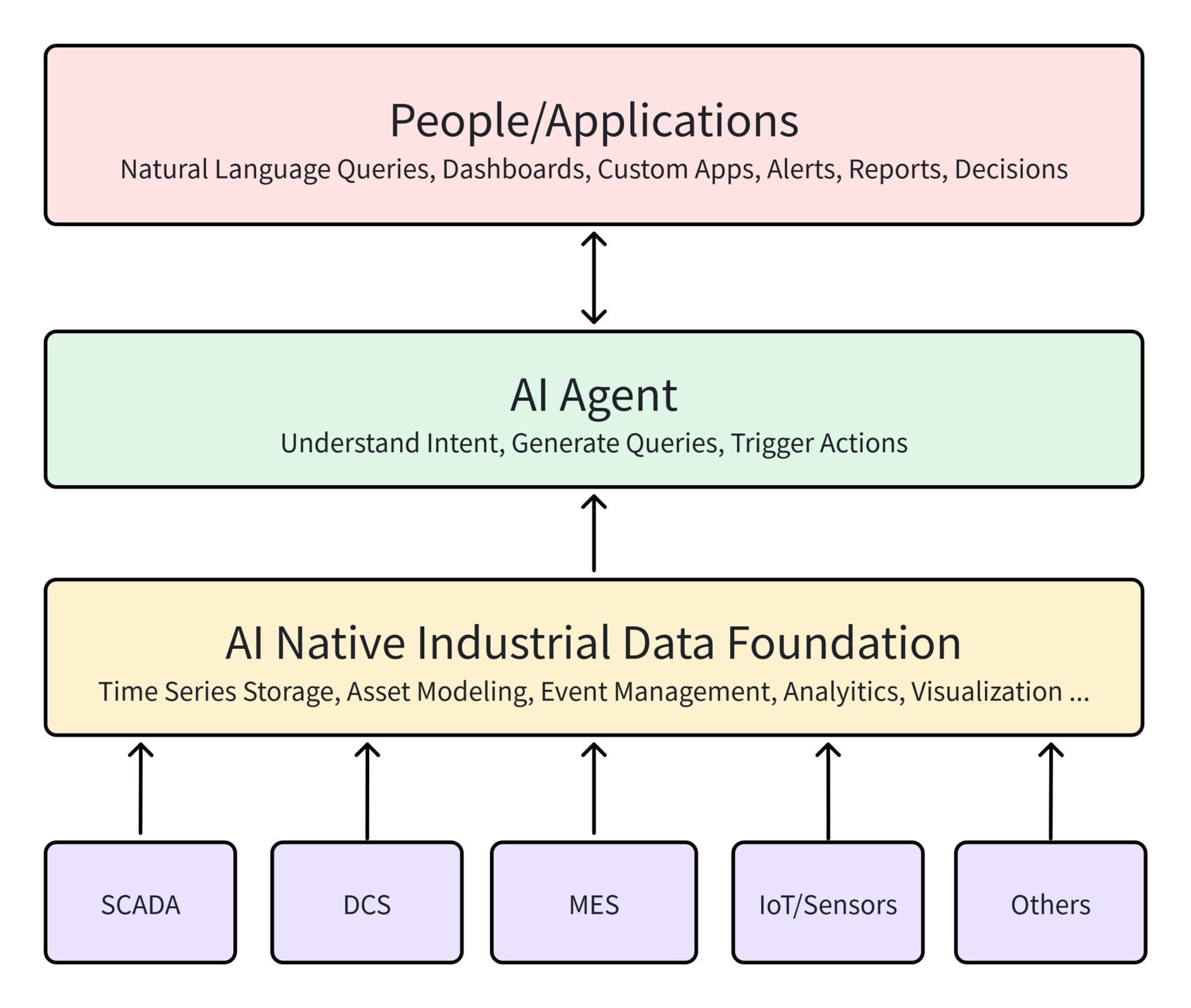
TDengine uses AI: TDengine’s own product evolution includes:
- TDgpt includes machine learning capabilities for anomaly detection, forecasting, and classification, allowing SQL to call time-series models and algorithms without first exporting data to Python.
- TDengine Historian packages industrial analysis methods through Process Analytics and AI-Powered Insights, putting stronger analysis capabilities in the hands of frontline engineers.
AI uses TDengine: AI agents can build on TDengine in several ways:
- AI Agents treat the TDengine SDK as a toolbox. As in this case, the developer gives the SDK docs to the AI, and the AI generates application code on top of TDengine.
- AI treats the TDengine Historian asset model as a semantic layer. The AI does not need to understand the low-level details of a time-series database. It only needs to understand the business semantics of “device, tag, attribute” to generate correct data access logic.
- AI treats TDengine’s real-time data as decision fuel. AI Agents can directly query TDengine’s real-time data, subscribe to TDengine Historian’s event streams, and make industrial decisions: suggesting process parameter adjustments, auto-triggering maintenance work orders.
Together, these two threads create a practical loop: TDengine brings AI into industrial data workflows, and AI agents can use TDengine as a reliable industrial data interface.
AI technology is still evolving quickly. For industrial enterprises, the durable advantage will come from the quality of their data foundation. TDengine is focused on helping those enterprises build that foundation for the AI era.
Outlook: the long-term value of the right data foundation
TDengine is still in the testing phase at this plant, but it is already connected to real plant-wide DCS alarm data. The team independently developed and deployed the Process Alarm Optimization Management Platform, a production-facing system aligned with international and national standards.
So far, the customer has mainly used TDengine Historian’s data assetization capability: modeling data and accessing it through the SDK. It has a set of more distinctive capabilities still untapped:
- Process Analytics. Deep analysis of the industrial production process, including batch comparison, trend analysis, multi-factor correlation analysis, sample clustering, and regression modeling. This helps domain experts understand not only what happened, but why it happened, so they can move toward proactive process control.
- AI-Powered Insights. Through Zero Query Intelligence, Chat BI, Panel Insights, and root cause analysis, the platform can support anomaly root-cause analysis, equipment health prediction, and process optimization recommendations, evolving from alarm management toward intelligent optimization.
- Event-driven automation. Analysis triggers Events, and Events trigger actions, closing the loop from alarm occurrence to diagnosis and resolution.
Once these capabilities are activated, the platform can evolve from an alarm management tool into an intelligent process optimization platform. Because the TDengine foundation is already in place, that upgrade does not require starting over. New capabilities can be layered onto the existing architecture. This is the long-term value of choosing the right data foundation.
Conclusion
Three days. One engineer without a formal software background. A process alarm optimization platform covering the full EEMUA 191 lifecycle.
When the industrial data foundation is strong enough, the data asset layer is clear enough, and AI is capable enough, industrial digitalization is no longer limited to large enterprise IT teams. Engineers who understand the business can participate directly.
TDengine’s goal is to provide an industrial data foundation that both people and AI agents can work with effectively.