Moving industrial time-series workloads to the cloud should make your data infrastructure easier to manage. But that depends on whether your database gives you the same product everywhere or adds another layer of complexity. This is where TDengine and AVEVA PI System take different paths.
One Unified Platform vs. Two Connected Systems
As a modern, AI-native industrial data platform and alternative to traditional data historians, TDengine provides a consistent foundation for on-premises, edge, and cloud deployments. Its core time-series engine, SQL interfaces, and client libraries work across deployment environments, while TDengine IDMP adds asset context, visualization, and advanced analytics.
PI System can be deployed in cloud-hosted environments, but extending an existing PI deployment with AVEVA CONNECT introduces a separate cloud data services platform. Transferring PI data to CONNECT requires an additional integration agent. In practice, that means operating and securing two platforms: the PI Server environment and the CONNECT cloud data service.
Cloud Deployment Comparison
| TDengine | PI System + AVEVA Connect | |
|---|---|---|
| Platform | On-prem: Windows or Linux Cloud: AWS, Azure, or GCP | On-prem: Windows only Cloud: Cloud-hosted PI Server; Azure-based CONNECT |
| Engine | Same core engine everywhere | Separate cloud service (AVEVA CONNECT) |
| Data Movement | Direct access; no extra broker or agent | Requires data-transfer agent |
| App Compatibility | Identical SQL, APIs, and clients | Different models for PI System and AVEVA CONNECT |
| Operational Scope | One platform to deploy / monitor | Two platforms + integration layer |
Edge–Cloud Synchronization
TDengine is built for seamless edge-cloud synchronization, giving enterprises the flexibility to deploy nodes at each site while also maintaining a centralized cloud platform where data from all sites is consolidated. At the edge, TDengine can continue local data storage and analysis during network interruptions. With edge–cloud synchronization configured and sufficient local retention, accumulated data can be synchronized to the cloud or a central data center when connectivity is restored. For enterprises that are fully on-premises, this architecture can also be used for synchronizing edge nodes to a data center or corporate office instead of the cloud.
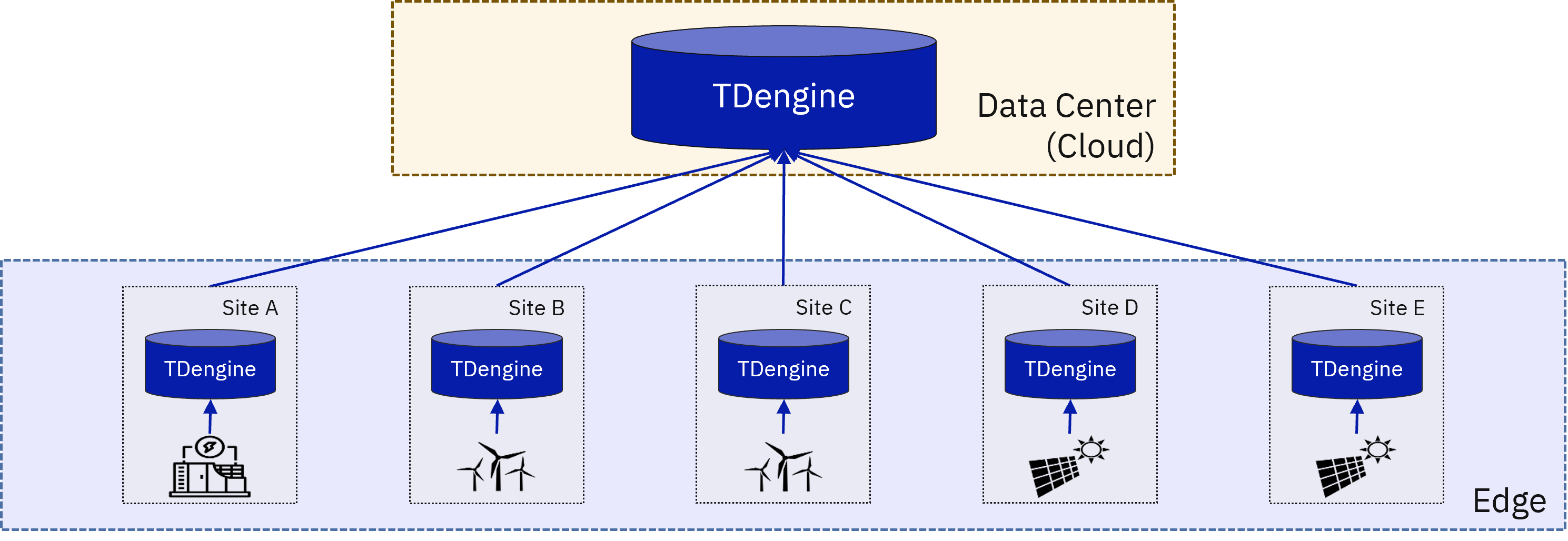
All TDengine instances, whether at the edge or in the cloud, share a consistent schema, asset framework, and metadata model. That means data from different facilities, lines, or regions can be analyzed together with zero transformation or reconfiguration. Enterprises gain a single, coherent view of operational data across every site, while still maintaining the ability to act locally on the edge for latency-sensitive or safety-critical use cases.
In contrast, PI System’s hybrid cloud strategy depends on external components such as PI-to-CONNECT agents and AVEVA CONNECT data services to bridge on-premises and cloud environments. This approach provides connectivity but not true synchronization: data must be published, replicated, or reformatted before it can be used in the cloud. As a result, real-time visibility and unified data modeling across sites are harder to achieve, and maintaining consistency between local and cloud systems requires additional configuration and operational effort.
Why the Difference Matters
With TDengine, you can run the same software at the edge, in the cloud, or both, and never experience compatibility issues or struggle with different interfaces. A single set of tools covers data ingestion and processing as well as system monitoring, backup, and security. And TDengine’s continuous, automated synchronization eliminates the need for custom scripts or third-party replication software.
Additionally, TDengine supports AWS, Azure, and GCP, so enterprises with existing cloud operations can select the service provider they prefer. Organizations that want to offload administrative work can select our fully managed TDengine Cloud, while those looking for more control can deploy self-hosted TDengine on their cloud servers.
By contrast, PI System’s cloud data services approach through AVEVA CONNECT adds another SaaS environment to configure, monitor, and budget for. In practice, this extra layer makes it harder to maintain a seamless experience across the entire data lifecycle, and already overburdened IT teams end up managing two distinct systems instead of one unified platform.
Final Take
If your cloud strategy is about portability and operational simplicity, TDengine offers a true “run-anywhere” model: one engine, one experience, on-premises or in the cloud.
Extending PI System with AVEVA CONNECT provides cloud data services, but at the cost of managing two distinct layers: tthe PI Server environment and the CONNECT Data Services platform. For many teams, that’s one platform too many.